


Quick Summary
Improving indoor air quality in small spaces starts with removing pollution sources, then ventilating and filtering the air you breathe. Small rooms hold less air, so pollutants build up fast. Match your ventilation to your window setup, and use a HEPA-based purifier sized to the room.
- Remove pollution sources first, since EPA says this is usually the most effective approach.
- A 300 sq ft studio with 8-foot ceilings holds about 2,400 cubic feet of air.
- Run a range hood that vents outdoors for 10 to 15 minutes after cooking.
- Keep indoor humidity roughly between 40% and 60%.
- Check outdoor AQI first: under 50 is a good time to ventilate.
Table of Contents
- Why Small Spaces Trap Pollutants Faster
- Step 1: Remove the Pollution Sources First
- Step 2: Ventilate Without Wasting Energy
- Step 3: Filter the Air You Already Breathe
- Step 4: Control Humidity, Dust and Plants
- Step 5: Set Up an Indoor Air Quality Monitor
- Clearing the Air in Your Bedroom and During Wildfire Smoke
- Choosing Your Next Step for Cleaner Air at Home
- Frequently Asked Questions
Why Small Spaces Trap Pollutants Faster
Last Updated: November 3, 2026
Improving indoor air quality in small spaces is easier than most people think, but it starts with knowing where the problem comes from. Small rooms hold less air, so pollutants build up quickly. A single candle, a spray can or a cooking session can change the air in a studio apartment within minutes.
The U.S. Environmental Protection Agency identifies three basic strategies for better indoor air: source control, ventilation, and air cleaners or filtration. EPA guidance on improving indoor air quality
Here is what makes small spaces different:
- Less air volume means pollutants concentrate faster
- Fewer windows and doors limit natural airflow
- Furniture and clutter trap dust and particles, so space-saving furniture picks can help keep compact rooms clear.
- Cooking, cleaning products and pets add pollution in a confined area
Cleaner air also affects how you think. Harvard Healthy Buildings indoor air quality research
Step 1: Remove the Pollution Sources First
Stop pollution at the source before you try to clean it up. The EPA says eliminating pollution sources or reducing their emissions is usually the most effective approach.
Start with the common culprits in a small home:
- Scented candles and air fresheners: Blow out the candle or switch to unscented options.
- Harsh cleaning products: Pick low-odor cleaners and store them with the lid closed.
- Smoking: Smoke indoors is one of the worst sources. Move smoking outside.
- Gas stove use: Run the range hood every time you cook.
- New furniture and materials: Choose low-emission paints and furnishings when you can.
Tip: Check your storage area. Paint cans, pesticides and solvents should be closed tight and kept out of the living space.
Step 2: Ventilate Without Wasting Energy
Fresh outdoor air dilutes indoor pollutants, and in a small space a short burst of ventilation can turn over a large share of the room's air volume. The catch is that most small apartments, dorms and home offices have one window, a window that opens only a few inches, or no operable window at all. Ventilation strategy has to match that constraint rather than assume cross-flow.
Start by measuring what you actually have. A 300 sq ft studio with 8-foot ceilings holds about 2,400 cubic feet of air. A single double-hung window opened 4 inches moves far less air than most people assume, so "crack a window" is not a plan on its own. Pair the window with a fan to force the exchange.
Match the method to your window situation:
- One window, opens fully: Place a box fan in the window blowing outward. This exhausts stale air and pulls replacement air in through gaps around the door and building envelope. Run it 15 to 20 minutes.
- One window, opens a few inches: Use a small window fan set to exhaust rather than a pedestal fan pointed at the room. Directed airflow at the opening does more than stirring the room.
- No operable window: Run the bathroom exhaust fan continuously on low and keep the interior door open so the negative pressure reaches the living area. This is slower but still moves air.
- Through-apartment cross-flow: If you have two openings on opposite sides, open both and put a fan blowing inward on the upwind side. This is the only configuration where the classic cross-flow advice applies.
Mechanical ventilation matters more in small sealed units. A range hood that vents outdoors (not a recirculating hood) should run every time you cook, and it should stay on for 10 to 15 minutes after the burner goes off. Bathroom exhaust fans should run during showers and for 20 minutes after.
Timing ventilation around outdoor conditions is the part most guides skip. Check the Air Quality Index for your ZIP code before opening windows.
Watch out: In a small space, ventilating during a cold snap or heat wave can swing the room temperature fast and push your HVAC to compensate, so ventilate in short bursts rather than leaving a window open for hours.
EPA guidance on improving indoor air quality
Ventilation strategy depends on your window setup, and the article's key options for small spaces compare as follows.
| Window situation | Method | Run time |
|---|---|---|
| One window, opens fully | Box fan in window blowing outward | 15 to 20 minutes |
| One window, opens a few inches | Small window fan set to exhaust | Directed at opening |
| No operable window | Bathroom exhaust on low, interior door open | Continuous |
| Two openings on opposite sides | Open both, fan blowing inward on upwind side | Cross-flow setup |
Step 3: Filter the Air You Already Breathe
Air purifiers help most when ventilation and source control are already in place. In a small room, the same purifier that is undersized for a living room can be more than adequate, because the unit has less air volume to clean. The number that matters is the clean air delivery rate (CADR), measured in cubic feet per minute for smoke, dust and pollen. Check a unit's rated CADR against your room size.
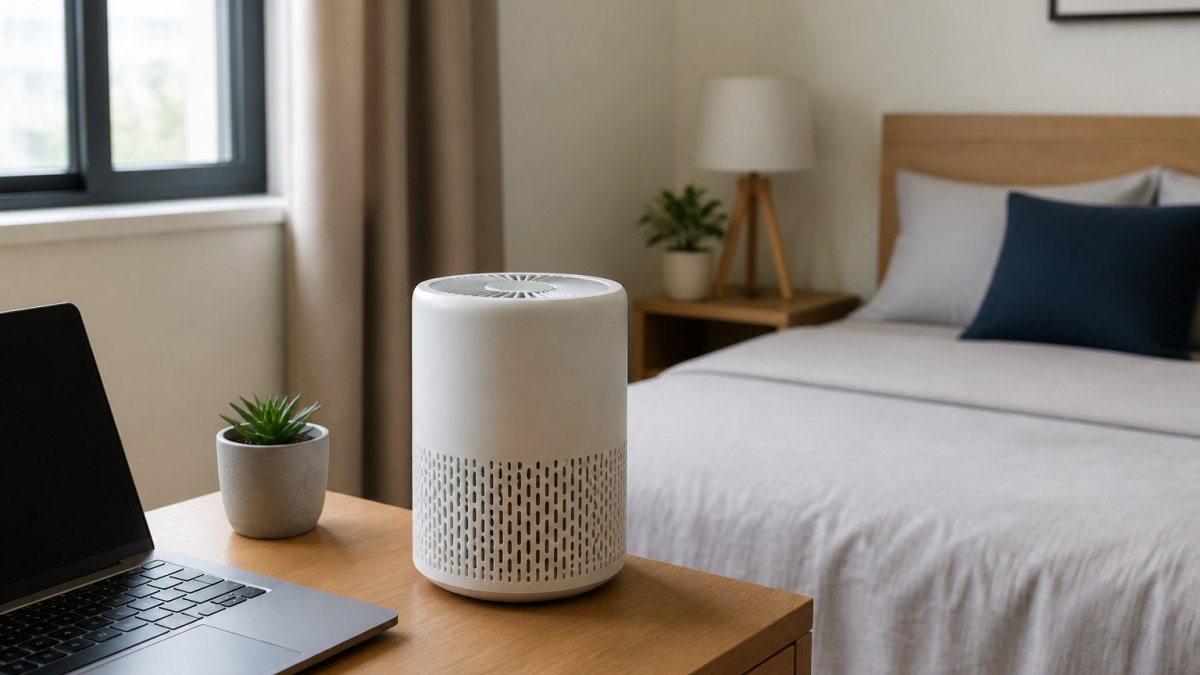
Filter type drives performance. True HEPA filters are designed to capture fine particles, which covers smoke, pollen and most fine dust. Electrostatic or electret filters capture charged particles and often move more air per dollar, but they lose efficiency as they load up. Carbon filters handle odors and volatile organic compounds but do little for particles, so a unit with both a HEPA stage and a carbon stage covers more ground in a small space where cooking and cleaning odors concentrate.
Portable Desktop Air Purifier & Smoke Remover →
Placement is where small rooms get tricky, and it is the part most guides skip. A purifier creates a clean-air zone around itself and leaves dead zones in corners, under desks and behind furniture. In a room under 300 sq ft:
- Put the unit on the floor or a low table near the center of the room, not tucked against a wall. Most units pull air in from the sides and push it out the top, so a few feet of clearance on all sides matters.
- Aim the outflow across the room toward the area where you sit or sleep, not into a wall or corner.
- Keep it out of the direct path between you and the door if you can, since foot traffic stirs settled dust back into the air.
- In a studio with distinct zones, one unit placed between the kitchen and the bed area covers both better than two small units at opposite ends.
- Run it on high during cooking and cleaning, then drop to low or auto for the rest of the day.
A portable desktop unit can clear smoke, odors and airborne particles from a workspace. The Portable Desktop Air Purifier & Smoke Remover from Jackie's Attic uses anion purification technology and a rechargeable 2400mAh battery for up to 90 minutes of use. It runs over USB and comes in black gold and black purple. Portable Desktop Air Purifier & Smoke Remover is priced at $113.41.

Watch out: A purifier running in a closed, sealed room with no ventilation will clean particles but will not reduce carbon dioxide or chemical buildup from off-gassing, so keep some ventilation in the routine even when the purifier is on.
Replace filters on the schedule the manufacturer gives, and sooner if you run the unit on high often or live with pets. A loaded filter drops airflow and CADR before it stops working entirely.
Step 4: Control Humidity, Dust and Plants
Humidity and dust both affect air quality in small spaces. Keeping indoor humidity roughly between 40% and 60% is a common guideline. Too much moisture can encourage mold, and dry air can irritate airways.
Keep dust under control with a simple routine:
- Vacuum with a HEPA-filter vacuum once a week
- Damp-dust surfaces instead of dry-dusting
- Wash bedding in hot water every one to two weeks
- Use a dehumidifier in damp rooms like bathrooms or basements
For pets, the Allerpet Pet Dander Remover (12 oz, $29.67) is designed to reduce pet dander at the source. Apply it weekly during grooming. Pet owners with allergies can also use the Pet Odor Eliminator for Litter Boxes, priced at $53.29, to keep odors down near litter areas.

Indoor plants are often suggested for better air. Treat them as a small supplement, not a substitute for ventilation or filtration.
Step 5: Set Up an Indoor Air Quality Monitor
You cannot manage what you do not measure. An indoor air quality monitor tracks particles, humidity, temperature and sometimes carbon dioxide or volatile organic compounds, so you can see when a source or room needs attention.
Use a monitor like this to:
- See spikes from cooking, cleaning or candles
- Check whether ventilation is working
- Confirm that humidity stays in the 40% to 60% range
- Decide when to run a purifier
Place the monitor at breathing height, away from direct sunlight, vents and the stove. Compare readings across a few days before you change habits.
Clearing the Air in Your Bedroom and During Wildfire Smoke
Bedrooms in small apartments often have the least airflow. Keep the door cracked when possible, run a purifier overnight on a low setting, and avoid smoking, incense or scented products in bed areas.
Wildfire smoke needs a different plan. Keep windows and doors closed, run a purifier on high, and use a recirculating setting if your home has one. Checking local air quality levels before you go outside is a sensible habit during smoke events. American Lung Association State of the Air 2026 report
Choosing Your Next Step for Cleaner Air at Home
Start with the step that costs the least and fixes the most. Remove sources, open windows when outdoor air is clean, and check humidity this week. Add a purifier or monitor once those basics are in place.
Shoppers who live in small homes often want gear that fits tight spaces. Our space-saving furniture picks help keep rooms uncluttered, and gadgets for small apartment living cover other tools that make compact homes easier to run.
Frequently Asked Questions
How do you fix poor indoor air quality in a small space?
Start with the source. Remove or reduce smoke, scented products and off-gassing materials before adding anything else. Then open a window for a few minutes when outdoor air is clean, run a bathroom or kitchen exhaust fan during use, and keep a small filtration unit running in the room where you spend the most time. In a small apartment, one well-placed device and a consistent habit of airing out the space usually make a bigger difference than buying several products at once.
How can I improve air quality in a bedroom without an air purifier?
Focus on ventilation and cleaning. Open a window before bed when outdoor air is good, and use a bedroom fan to move air. Wash bedding weekly in hot water to cut dust mites, vacuum with a HEPA-filter vacuum, and keep humidity between 40% and 60%. Avoid burning candles or incense in the room, and keep pets out of the bedroom if they trigger allergies. These steps cost little and address the most common sources of bedroom pollution.
Do indoor air quality monitors help in small spaces?
Yes, because they show you what you cannot smell. A monitor that tracks particulate matter, carbon dioxide and humidity tells you when a room has gone stale or when cooking, cleaning or a candle has spiked pollutant levels. In a small space, those spikes build up quickly, so a monitor helps you decide when to open a window or run a fan. Place it at breathing height, away from vents and direct sunlight, for readings that reflect the air you actually breathe.
How should I improve indoor air quality during wildfire smoke?
Keep windows and doors closed while smoke is heavy outside, and run a portable air cleaner with a HEPA filter in the room you occupy most. Set your HVAC system to recirculate and change filters more often than usual. Check your local Air Quality Index from AirNow.gov and avoid adding extra pollution by vacuuming, burning candles or frying food during smoky periods. Filtration matters most during these events because outdoor smoke can enter even tightly sealed homes.


