


Quick Summary
Space saving furniture is the most practical answer for small modern homes, because each piece folds, stacks, or stores something else so one item does the job of two. Choose pieces by the daily problem they solve, like hosting guests or clearing the dining table, and not by how compact they look.
- A queen wall bed needs about 7 feet of clear floor in front of the wall when open.
- Wall beds are permanent installations, so check your lease before drilling if you rent.
- Folding desks should fold to 12 inches deep or less so they clear a walkway.
- Drop-leaf tables are one of the easiest space-saving upgrades for almost any small apartment.
- Add storage in order: under the bed first, then vertical wall space, then built-ins.
Table of Contents
- Why Space Saving Furniture Works Best in Modern Homes
- Multifunctional Furniture for Small Spaces
- Space-Saving Furniture for Small Apartments: Wall Beds, Folding Desks and Drop-Leaf Tables
- Small Living Room Furniture Ideas That Free Up Floor Space
- Storage Furniture for Small Homes: Built-Ins, Beds and Hidden Storage
- Measuring, Clearances and Budget Before You Buy
- Book a Layout Review or Shop Jackie's Attic's Current Lineup
- Frequently Asked Questions
Why Space Saving Furniture Works Best in Modern Homes
Last Updated: October 29, 2026
Modern homes are getting smaller, and the furniture inside them has to work harder.
Think of it as a trade. You give up a little bulk and some visual simplicity, and you gain floor space and flexibility.
Many shoppers are starting with the wrong question.
Here's the core idea. Space-saving furniture earns its place when it reduces clutter and gives you back usable floor area.
Multifunctional Furniture for Small Spaces
Multifunctional furniture serves more than one purpose. A sofa becomes a bed, a coffee table hides storage, and a bench holds shoes and blankets. The goal is simple: fewer pieces, more uses.
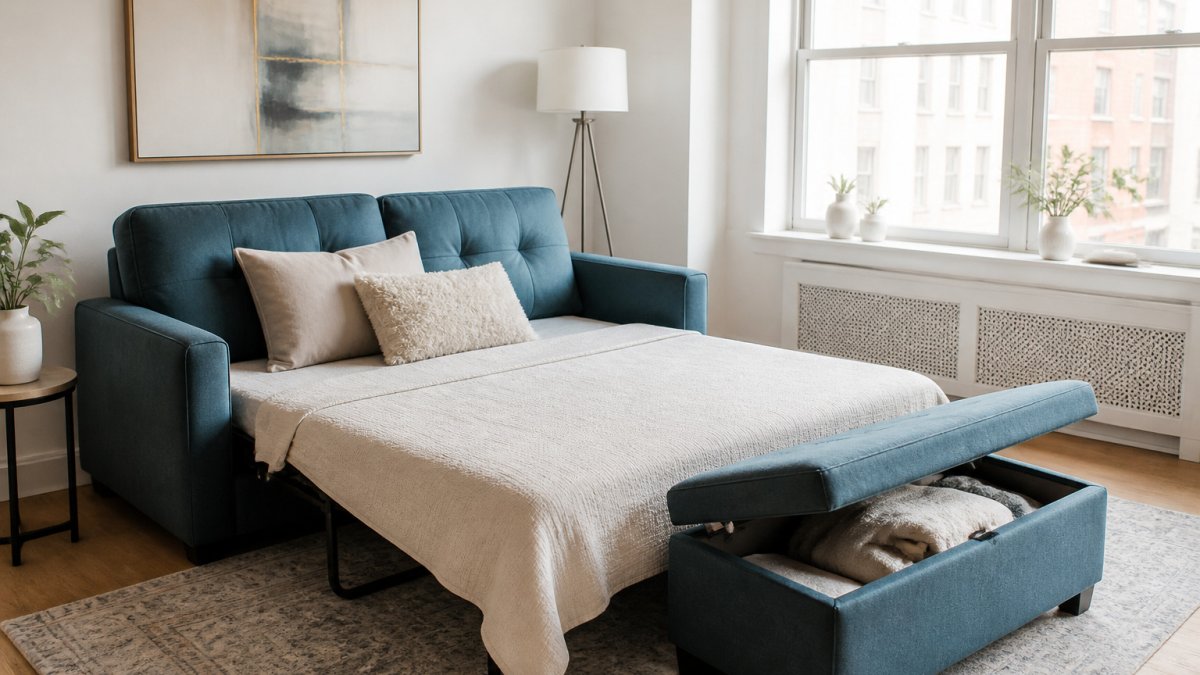
Sofa Beds and Sleeper Sofas for Guests
A sleeper sofa is usually the first piece people consider when space is tight. It handles daily seating and occasional overnight guests without a separate bed in the room.
Check three things before you buy. First, the mattress thickness, since thin pull-out mattresses can be uncomfortable for regular use. Second, how the mechanism opens, and whether you have room to pull it out fully. Third, whether the frame holds up to repeated conversion.
A reader weighing this option for guests may want to see a folding sofa bed they could actually buy. Our Folding Nest Sofa Bed shows what a convertible design looks like in practice.
Storage Ottomans and Coffee Tables
Storage ottomans and coffee tables are quiet workhorses. They give you a surface, a seat, and a place to stash blankets, games, or chargers. Look for a lid that opens smoothly and a size that fits your room without blocking walkways.
Space-Saving Furniture for Small Apartments: Wall Beds, Folding Desks and Drop-Leaf Tables
Some pieces only make sense in a small apartment, and they are often the most effective. Wall beds, folding desks, and drop-leaf tables can flatten or fold away when you don't need them. The trick is choosing between them on measurable criteria rather than on how clever they look in a showroom.
Compare the four workhorses side by side
| Furniture type | Typical closed footprint | Typical open footprint | Storage it adds | Conversion effort | Renter-friendly? |
|---|---|---|---|---|---|
| Wall bed (queen) | About 7 to 9 sq ft of wall face, 16 to 22 in deep | Roughly 60 to 85 sq ft of floor | None unless paired with side cabinets | High: clear the floor, pull down, dress the bed | No, needs wall anchoring into studs or masonry |
| Folding desk | 24 to 48 in wide, 6 to 12 in deep when folded | 24 to 48 in wide, 20 to 24 in deep when open | Small shelf or cubby on some models | Low: one or two hinges or a lift mechanism | Usually yes if it is a freestanding or wall-leaning model |
| Drop-leaf table | 12 to 24 in deep against the wall | 30 to 48 in across with one or both leaves up | None | Low: lift and lock the leaf | Yes, freestanding |
| Extendable dining table | Same as a standard table when closed | Adds one or two leaves, often 12 to 20 in each | None | Medium: store leaves, slide or crank the mechanism | Yes, freestanding |
Treat those ranges as shopping filters, not specs. Always confirm the exact open and closed dimensions on the product page, because a few inches decides whether a piece fits your room.
Wall beds: plan the wall before the bed
A wall bed, also called a Murphy bed, is the most space-efficient sleeping solution for a studio or a guest room that doubles as an office. It is also the least forgiving. A wall bed needs a wall that can carry the bed, the mattress, and the frame, plus the force of someone pulling it down. Check the installation requirements on the product page before you buy.
Measure three things before you buy:
- Wall face: the bed's closed width and height, plus any side cabinets.
- Floor clearance: the full open length of the mattress plus room to stand at the foot. A queen wall bed commonly needs about 7 feet of clear floor in front of the wall when open.
- Ceiling and trim: baseboards, crown molding, and light fixtures can block the frame or the mattress.
Folding desks: match the desk to the workday
A folding desk works well in a hallway, against a bedroom wall, or in a shared room that needs to become an office for a few hours. The trade-off is surface area and stability.
Look for a desk that locks flat when open, has a weight rating that covers your monitor and laptop, and folds to 12 inches deep or less so it clears a walkway.
Drop-leaf and extendable tables: the simplest upgrade
Drop-leaf tables are one of the easiest space-saving wins. Leaves fold down when you're done eating, so a table for four can live against a wall as a 12- to 24-inch-deep console.
Extendable tables suit households that host occasionally but want a full-size table the rest of the time. They are heavier and need storage for the leaves, so measure your closet or under-bed space before you commit.
Small Living Room Furniture Ideas That Free Up Floor Space
Floor space is the scarcest resource in a small living room. The best layouts keep walkways open and avoid pieces that block natural paths.
Start with a single large rug to anchor the seating area.
One common mistake is buying a sectional that fills the whole wall.
Watch out: a sofa bed that looks spacious when closed can overwhelm a room when opened. Check the open dimensions, not just the closed ones.
Storage Furniture for Small Homes: Built-Ins, Beds and Hidden Storage
Storage furniture reduces clutter by giving everything a home, and in a small home it often does more for usable space than any folding mechanism. The goal is to add capacity without adding footprint, so the best pieces store inside the volume you already occupy: under the bed, inside the sofa, above the door, or in a corner.
Match the storage type to the room
| Storage type | Where it works best | Typical capacity | Installation | Renter-friendly? |
|---|---|---|---|---|
| Storage bed with drawers | Bedroom with little closet space | Two to four drawers, often 6 to 10 in deep | Assembly only | Yes |
| Lift-up storage bed | Bedroom, guest room | Full under-mattress well, several cubic feet | Assembly only | Yes |
| Storage ottoman | Living room, entryway, foot of bed | Blankets, games, shoes | None | Yes |
| Lift-top coffee table | Living room | Laptops, remotes, throws | None | Yes |
| Built-in cabinets and wardrobes | Bedroom, hallway, awkward corners | Highest, floor to ceiling | Permanent, often anchored | No |
| Wall shelves and floating cabinets | Any room with clear wall space | Moderate, depends on depth | Anchored into studs | Usually no |
Storage beds: the highest-capacity renter-friendly option
Storage beds are especially useful in bedrooms with little closet space. A bed with drawers underneath can hold seasonal clothes or linens, and a lift-up bed gives you a full under-mattress well for suitcases and off-season bedding.
Measure the room with the drawers open, not just closed. A drawer that pulls out 18 inches needs 18 inches of clear floor in front of the bed.
Built-ins and vertical storage: highest capacity, least flexible
Built-in cabinets and wardrobes make the most of vertical space and unused corners, which many small rooms waste. Floor-to-ceiling units can roughly double the storage of a freestanding dresser in the same footprint. The trade-off is flexibility: built-ins are fixed, so you need to be sure about the room layout before installing them, and they usually require anchoring and sometimes professional installation.
If you rent, favor freestanding wardrobes, wall-leaning ladder shelves, and over-the-door organizers. They give you vertical storage without drilling, and they move with you.
Hidden storage: keep everyday items close
Hidden storage, such as a bench with a lift-top or a coffee table with drawers, keeps everyday items close without showing them. The best hidden storage is where you already sit or set things down: an entryway bench for shoes, an ottoman for throws, a coffee table for remotes and chargers. Look for soft-close hinges and a lid that stays open on its own, since a lid that slams is a lid you stop using.
The main trade-off across all storage furniture is flexibility versus capacity. Freestanding storage pieces can move with you and reconfigure as your needs change. Built-ins hold the most but lock in your layout. For most small homes, a mix of storage bed, vertical shelves, and one or two hidden-storage pieces covers daily needs without a permanent commitment.
Measuring, Clearances and Budget Before You Buy
Measurements make or break a space-saving purchase. Measure the room, doorways, and hallways, then write down the open and closed dimensions of each piece.
Budget matters too. Convertible and multifunctional furniture usually costs more than single-purpose pieces, so ask what you will use every week.
Durability is the other question. Check the hinge hardware, drawer slides, and mechanism reviews before buying. Pieces that convert often need sturdier frames.
Book a Layout Review or Shop Jackie's Attic's Current Lineup
If you are not sure which piece fits your room, a layout review is the fastest way to decide.
For current pricing and availability, check Jackie's Attic's website or contact the team directly.
Start with one room, measure carefully, and choose the piece that solves your most frequent problem. Space-saving furniture works best when it earns its footprint every day.
Frequently Asked Questions
What furniture is best for saving space?
Furniture that does two jobs tends to save the most room. Sofa beds, storage ottomans, drop-leaf tables and wall-mounted desks all free up floor space when they are not in use. Choose pieces that fold, stack or store items inside, and measure the room before buying so each piece fits its clearance without blocking doors or walkways. Pricing varies by material, size and finish, so check Jackie's Attic's website for current prices and availability.
Are wall beds or sofa beds better for small spaces?
It depends on how often you host guests and how much floor area you have. A wall bed frees the most floor space because it folds flat against the wall, but it needs wall clearance and sometimes professional installation. A sofa bed works as everyday seating and provides a guest sleeping option without mounting hardware, though it takes up more floor area when open. Compare the mattress size, folded depth and weight before choosing.
How do I arrange furniture in a small room?
Start by marking the room's dimensions and the walkways you need, usually at least 30 inches wide for a path through a room. Place the largest multifunctional piece first, then fit smaller items around it. Keep seating close to a wall or a corner to open the center of the room, and leave room for doors and drawers to open fully. Test the layout with painter's tape on the floor before moving anything heavy.
What should I look for when buying space-saving furniture?
Look for accurate folded and open dimensions, weight capacity, and the mechanism used to convert the piece. Check whether the hardware is sturdy and whether the finish holds up to daily use. Consider long-term value over the lowest sticker price, since a well-built piece lasts longer. Confirm return and shipping terms before ordering, and review Jackie's Attic's current policies on its website.


