


Last Updated: November 6, 2026
Quick Summary
Sink depth is the distance from the sink rim to the lowest point of the basin, and it decides whether a faucet will reach the water. Measure from the rim straight down to the basin floor, not to the drain flange. Record this alongside front-to-back depth and sink type before comparing faucet specs.
- Measure to the basin floor, not the drain flange, which adds height and overstates depth.
- Measure front-to-back depth straight across the inside rims, not on a diagonal.
- Note whether the sink is top-mount or undermount, since mounting changes the reach needed.
- Compare faucet spout height to basin depth so the outlet clears the rim.
- Confirm faucet reach against your target distance to the basin center before ordering.
Table of Contents
- Why Sink Depth Matters for Faucet Fit
- How to Measure Sink Depth Step by Step
- Standard Kitchen Sink Hole Size and Hole Count
- How to Measure Kitchen Sink Faucet Size
- How to Measure a Sink Faucet for Replacement
- Common Measurement Errors and How to Avoid Them
- Your Faucet Compatibility Checklist Before You Order
- Frequently Asked Questions
Why Sink Depth Matters for Faucet Fit
Sink depth is the distance from the sink rim to the deepest point of the basin, and it is one of the measurements that decides whether a faucet will fit your setup.
A typical kitchen sink is about 22 inches by 30 inches, with a depth of 7 to 10 inches, according to a HOROW kitchen sink dimensions guide. Those general numbers are a useful starting point. They do not tell you whether your specific faucet will work with your specific sink.
Depth matters because a faucet has to reach over the rim and land water in the basin. Shallow sinks need less spout height. Deep sinks need a taller spout or a longer reach.
How to Measure Sink Depth Step by Step
The word "depth" causes more faucet returns than almost any other measurement, because it means at least three different things in a kitchen sink listing. Before you put a tape measure to anything, decide which depth you actually need:
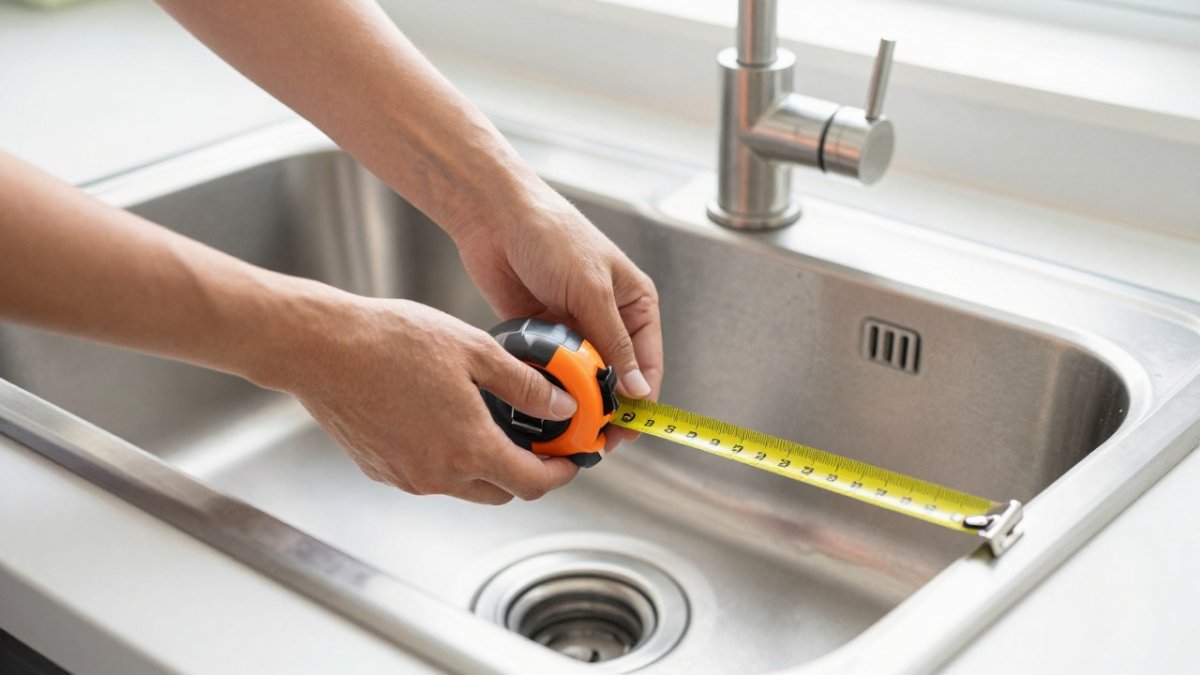
- Basin depth, the vertical distance from the sink rim down to the lowest point of the bowl. This is what determines whether a tall faucet will clear the rim and whether a deep sink will leave the spout too high to be useful.
- Front-to-back depth, the horizontal distance from the front rim to the back rim. This is the dimension that tells you how much room the spout has to reach over the bowl before it hits the back wall.
- Overall sink depth, the full front-to-back footprint of the sink body, including any rim or lip. This matters for cabinet and countertop fit, not for faucet reach.
For faucet compatibility, basin depth and front-to-back depth are the two that matter. Record both, and label them clearly so you do not compare the wrong number to a faucet spec sheet.
Measuring Basin Depth (Rim to Lowest Point)
You need a tape measure or a stiff ruler and a few minutes. Measure twice and write the number down before you shop.
- Clear the sink and remove drying racks, dish bins and the stopper.
- Run your hand across the bottom of the basin. Most sinks slope slightly toward the drain, so the lowest point is usually near the drain opening, not the geometric center of the bowl.
- Stand a ruler on that lowest point and hold it plumb (straight up) to the rim.
- Read the measurement where the top of the rim meets the ruler. That is your basin depth.
- Repeat for the second bowl on a double sink, the two bowls are often not identical.
Sink depths vary widely, so do not rely on averages. Measure your own bowl.
Watch out: Measuring to the top of the drain flange instead of the true basin floor adds roughly the height of the flange to your number and makes the sink look deeper than it is.
Measuring Front-to-Back Depth and Rim Position
Front-to-back depth is the horizontal measurement the faucet has to span. Measure from the inside edge of the front rim to the inside edge of the back rim, straight front to back, not on a diagonal.
Then note where the rim sits relative to the countertop:
- Top-mount (drop-in) sinks rest their rim on top of the counter. The faucet base sits behind the rim, so the spout has to clear the rim height plus reach over the bowl.
- Undermount sinks attach below the counter, so the counter edge, not a sink rim, is what the faucet must clear. The effective front-to-back distance from the faucet base to the far side of the bowl is usually longer than on a top-mount sink of the same nominal size.
Write down the sink type next to your front-to-back number. Two sinks with identical footprints can need different spout reaches depending on how they mount.
Recording Your Depth Measurements
Keep a simple note with four lines: basin depth, front-to-back depth, sink type (top-mount or undermount), and the number of bowls. Add the hole count and center-to-center spread once you have measured those. Every faucet spec sheet lists reach and height, and you will compare those two numbers against this note, so the note has to be unambiguous about which depth is which.
The article distinguishes three kinds of depth, and the two that matter for faucet fit are basin depth and front-to-back depth.
| Depth type | What it measures | Why it matters for faucet fit |
|---|---|---|
| Basin depth | Sink rim to lowest point of the bowl | Decides whether a tall faucet clears the rim and reaches the water |
| Front-to-back depth | Inside front rim to inside back rim | Shows how far the spout must reach over the bowl |
| Overall sink depth | Full front-to-back footprint including rim | Matters for cabinet and countertop fit, not faucet reach |
Standard Kitchen Sink Hole Size and Hole Count
Many kitchen sinks come with pre-drilled holes for the faucet, sprayer or soap dispenser. Count these holes before you buy anything. A single-hole sink takes a single-handle faucet.
Check the spacing between holes too. Center-to-center spread is the distance between the faucet mounting holes, and most faucets list this measurement. If your sink has no holes, your countertop or sink deck will need drilling before installation.
How to Measure Kitchen Sink Faucet Size
Faucet size is not one number. Four measurements decide whether a faucet works with your sink: spout height, spout reach, deck thickness and hole configuration. Measure all four before you compare anything to a spec sheet.
Measuring Spout Height and Overhead Clearance
Spout height is the vertical distance from the base of the faucet (where it meets the deck) to the highest point of the spout, usually the top of the arc or the top of the pull-down head. Measure from the deck surface up, not from the bottom of the counter.
Compare that height to two things:
- Basin depth. A shallow basin with a very tall spout puts the outlet far above the water line and invites splashing. A deep basin with a short spout can leave the outlet below the rim, so water hits the back wall.
- Overhead clearance. Check for a window sill, upper cabinet, shelf or backsplash that the faucet arc or a pull-down head would hit when it swings. Measure from the deck to the lowest obstruction behind the sink.
Calculating Spout Reach and the Stream Landing Point
Spout reach is the horizontal distance from the center of the faucet base to the center of the spout outlet.
To predict the landing point:
- Measure from the center of the faucet mounting holes to the center of the basin (front-to-back). Call this the target distance.
- Find the faucet's listed reach.
- Compare. If reach is shorter than the target distance, the stream lands toward the back of the bowl, near the wall. If reach is much longer, the stream lands toward the front or past the drain.
The goal is a landing point near the middle of the basin, slightly behind the drain, so water rinses the bowl without splashing over the front rim.
Watch out: Reach is measured to the spout outlet, not to the tip of a pull-down head that extends when pulled.
Checking Deck Thickness and Mounting Limits
Deck thickness is the thickness of the material the faucet clamps through, the countertop on an undermount sink, or the sink deck on a top-mount.
Measure the deck at the faucet hole, from the top surface to the underside where the mounting nut and washer will sit.
Also check under-counter clearance. A faucet base needs room below the deck for the mounting shank, washer, nut and supply connections.
Matching Hole Count and Escutcheon Size
Hole configuration is the last compatibility check:
- One hole takes a single-hole faucet, or a three-hole faucet with a deck plate (escutcheon) that covers the unused holes.
- Three holes take a centerset or widespread faucet. Measure the center-to-center spread and match it to the faucet's listed spread.
- No holes means the countertop or sink deck must be drilled, which changes the installation plan.
Measure the width and depth of the faucet's escutcheon or deck plate and confirm it covers your existing holes and sits flat on the deck.
Write all four numbers, spout height, reach, deck thickness and hole spread, next to your sink depth note. With those in hand, you can compare any faucet's spec sheet to your sink in under a minute.
How to Measure a Sink Faucet for Replacement
If you are replacing a faucet, measure the old one before removing it. Note the hole count, the center-to-center spread, the spout height and the reach.
Replacement faucets do not always match exactly. Use these measurements to find a model that fits your existing holes.
If your current faucet is leaking at the base, check the shut-off valves first. The guide how to fix a leaky kitchen faucet shut-off valve covers that step before you swap the faucet.
Common Measurement Errors and How to Avoid Them
Most fit problems come from a few simple mistakes:
- Measuring sink depth from the rim to the drain instead of the basin floor
- Forgetting to count existing holes before shopping
- Ignoring deck thickness and under-counter clearance
Measure every number twice. Write each measurement next to the sink's shape and hole count. A quick note saves a return.
If you need to replace the aerator as part of the same job, the guide replace a kitchen faucet aerator step by step walks through that process.
Your Faucet Compatibility Checklist Before You Order
Before you buy, confirm each item:
- Sink depth measured to the deepest point of the basin
- Sink length and width recorded
- Number of existing faucet holes counted
If every box is checked, you are ready to order. If the numbers do not match, keep shopping.
Shoppers who want to compare options can also read how to choose a kitchen sink splash guard in 5 steps before finishing the purchase.
Get the right kitchen faucet fit the first time. Browse the Jackie's Attic collection, check the specs against your measurements, and order with confidence.
Frequently Asked Questions
How do I know if a faucet will fit my kitchen sink?
Start by counting the mounting holes on your sink deck, usually one, three or four, and measuring the center-to-center spacing between them. Then compare that spacing to the faucet's base plate. Check the spout reach so it lands over the center of the basin, and confirm your sink depth leaves room for the supply lines and the faucet body underneath. If the hole count and spacing match the faucet's specifications, the faucet will almost always fit. Check the product details before you buy so you can make the comparison.
How do you measure kitchen sink depth?
Place the end of a tape measure or ruler at the deepest point of the basin, which is usually the bottom center. Measure straight up to the top edge of the sink rim. Keep the ruler vertical so you do not overstate the depth. Record the number in inches. Most standard kitchen sinks measure about 7 to 10 inches deep, while shallow sinks may be closer to 6 to 8 inches. Knowing this number helps you check whether a faucet's supply lines and body have enough clearance under the deck.
Can I use an 8-inch faucet with 4-inch holes?
Usually not. An 8-inch faucet, meaning the center-to-center spread of its base, is designed for sinks with 8-inch spaced holes. A 4-inch spread faucet needs holes spaced 4 inches apart. Some faucets have adjustable or mini-spread bases that fit a range of spacings, so check the product specifications before assuming compatibility. If the spacing does not match, you may need a deck plate or a different faucet. Measure the center-to-center distance between your existing holes to confirm.
How much space do you need between a sink and a faucet?
The faucet needs enough room behind the sink rim and enough clearance from walls, backsplashes and windows to operate comfortably. Measure from the faucet's base to the nearest wall or backsplash, and confirm the spout can swing without hitting it. Allow room for the handle to move freely as well. Check the manufacturer's clearance guidance for the specific faucet before installing, since requirements vary by model.


