


Last Updated: October 24, 2026
Quick Summary
Energy-efficient lighting solutions reduce your home's electricity consumption by nearly 40% when you switch to LED bulbs and combine them with smart controls and proper fixture selection. Lighting accounts for about 15% of an average home's electricity use, making it one of the easiest places to cut costs without sacrificing comfort.
- LED bulbs use 9 watts to produce the same 800 lumens as 60-watt incandescent bulbs and last 25,000+ hours versus 1,000 hours.
- A 9-watt LED costs about $1 per year to operate compared to roughly $60 per year for a 60-watt incandescent bulb.
- Automated dimming based on natural daylight reduces lighting consumption by 20-30% in addition to bulb efficiency gains.
- The share of households using mostly LED bulbs for indoor lighting rose from 4% in 2015 to 63% in 2024.
- LED bulb upgrades for 30 sockets typically pay back in under one year through electricity savings alone.
Table of Contents
- Why Energy-Efficient Lighting Solutions Matter for Your Home
- Understanding Energy-Efficient Light Bulbs and How They Work
- Smart Lighting Solutions That Adapt to Your Daily Routine
- Lighting Controls and Dimmers: Fine-Tuning Brightness and Savings
- Choosing the Best Light Bulbs for Each Room
- Calculating Your Return on Investment and Long-Term Savings
- Getting Started with Your Home Lighting Upgrade
- Frequently Asked Questions
Why Energy-Efficient Lighting Solutions Matter for Your Home
Your home's lighting system consumes more electricity than you probably realize. According to the U.S. Department of Energy Consumer Guide to Energy-Efficient Lighting, lighting accounts for about 15% of an average home's electricity use.
Energy-efficient lighting solutions for home have transformed over the past decade.
The transition is already underway. According to the U.S. Energy Information Administration, the share of households using mostly LED bulbs for indoor lighting rose from 4% in 2015 to 63% in 2024.
Homes that adopt LED lighting solutions can reduce their electricity usage by nearly 40%, and combining efficient bulbs with smart controls and proper fixture selection yields even greater savings.
Understanding Energy-Efficient Light Bulbs and How They Work
The core of any energy-efficient lighting strategy starts with the bulb. LED stands for light-emitting diode, and it works fundamentally differently from incandescent bulbs.
Incandescent bulbs waste energy as heat. According to the University of Florida Institute of Food and Agricultural Sciences, LEDs are small, durable, available in varied colors and forms, and potentially more energy efficient.
The practical difference is stark:
- Incandescent bulbs: 60-watt bulb produces 800 lumens, lasts about 1,000 hours
- LED bulbs: 9-watt bulb produces 800 lumens, lasts 25,000+ hours
- Energy cost: Incandescent costs roughly $60 per year to operate; LED costs about $1 per year for the same light output
An LED lasting 25,000 hours might not need replacing for 10+ years in average household use, fewer trips to the store, less waste, and lower costs.
Here's how incandescent, LED, and CFL bulbs compare in real-world performance and cost.
| Bulb Type | Wattage for 800 Lumens | Lifespan | Annual Operating Cost |
|---|---|---|---|
| Incandescent | 60 W | 1,000 hours | $60 |
| LED | 9 W | 25,000+ hours | $1 |
| CFL | Between incandescent and LED | Moderate | Between incandescent and LED |
Smart Lighting Solutions That Adapt to Your Daily Routine
The energy savings stack up quickly:
- Automated dimming based on natural daylight reduces consumption by 20-30%
- Occupancy sensors eliminate lights left on in empty rooms
- Scheduling ensures lights turn off when you're away
Connect lighting to your thermostat, security system, or voice assistant, and motion sensors in hallways and bathrooms ensure light only when needed.
Smart bulbs cost more upfront, $15-25 versus $2-5 for a basic LED, but savings and convenience often justify the investment within 1-2 years.
Start small: install smart bulbs in high-use areas like bedrooms, kitchens, and living rooms, then expand as you get comfortable.
Lighting Controls and Dimmers: Fine-Tuning Brightness and Savings
Dimmers and controls are where most lighting upgrades go wrong: the bulb is efficient, the switch is installed, and then the light flickers, buzzes, or refuses to dim below 30%. Here's how to avoid the compatibility traps.
How dimming actually saves energy
Dimming an LED does not save energy in a straight line. At 50% brightness an LED typically draws less than half its rated wattage because the driver runs more efficiently at lower output, so dimming to half often cuts consumption by 50-70%.
The compatibility checklist before you buy
- Is the bulb dimmable? Check the packaging. Many cheap LEDs are not, and a non-dimmable LED on a dimmer will flicker or fail early.
- Is the dimmer LED-rated? Old incandescent dimmers use leading-edge phase control that many LED drivers dislike. Look for dimmers explicitly rated for LED or CFL loads, often labeled with a minimum load in watts.
- What is the minimum load? Many LED-rated dimmers need at least 10-25 watts of connected load to work reliably. A single 9-watt LED on a dimmer rated for a 25-watt minimum may flicker. Either add more bulbs to the circuit or choose a dimmer with a lower minimum.
Controls that pay for themselves
- Occupancy and vacancy sensors. Best for bathrooms, laundry rooms, closets, garages, and hallways, rooms where lights are left on by accident. Vacancy sensors (manual-on, auto-off) are often preferred in rooms where you want deliberate control.
- Schedules and timers. Useful for exterior lights and for households with predictable routines. A schedule that turns off lights at bedtime eliminates the most common waste.
- Smart switches vs. smart bulbs. A smart switch controls the whole circuit and works with any dimmable bulb, which is usually cheaper per room than outfitting every socket with a smart bulb. Smart bulbs make sense for lamps and for color-tuning in a single fixture.
Installation realities
Most smart switches fit standard U.S. wall boxes and work with existing wiring, but three things trip people up: older homes may lack a neutral wire in the switch box (many smart switches require one), multi-way circuits need compatible companion switches, and dimmable LED loads sometimes need a neutral at the fixture too. If that's unfamiliar, call an electrician. Budget roughly $100-300 per switch installed.
When controls are not worth it
If a room is used briefly and predictably, a plain switch and an efficient bulb capture most of the savings. Controls earn their cost in rooms with irregular use (bathrooms, hallways, garages), where dimming improves comfort (living rooms, bedrooms), and on exterior circuits left on all night.
Choosing the Best Light Bulbs for Each Room
Not all bulbs suit all spaces. Brightness, color temperature, and fixture compatibility vary by room and use case.
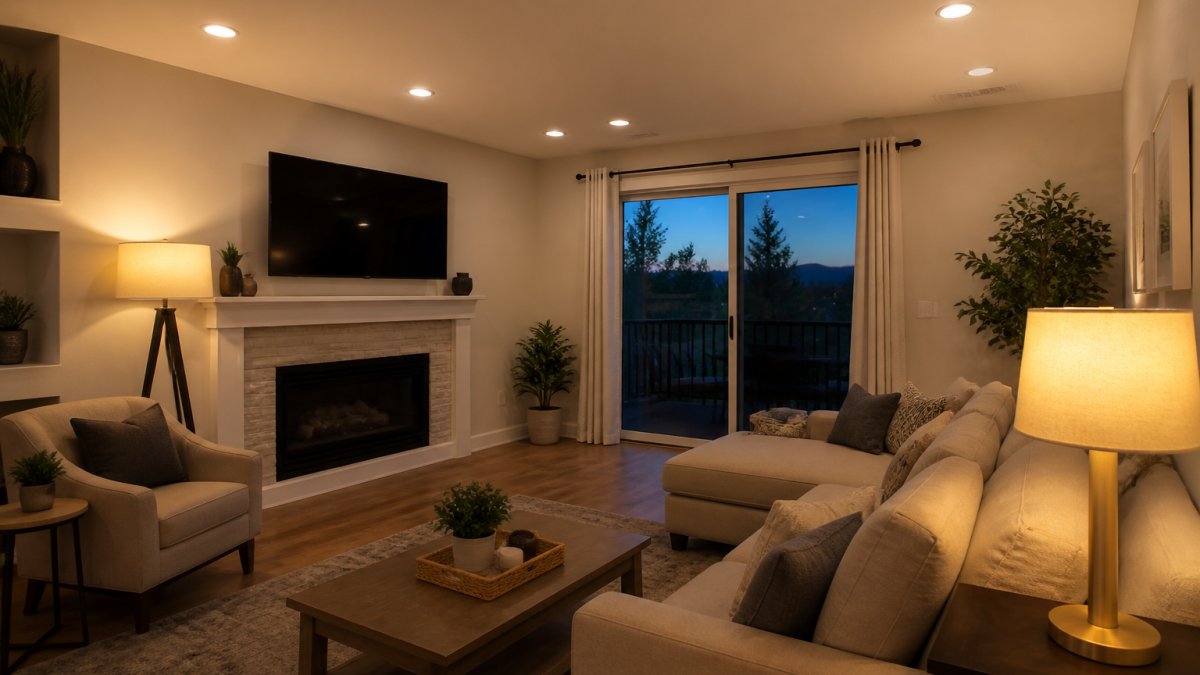
Living Areas and Bedrooms
Living rooms and bedrooms benefit from warm light, target 2700K (warm white), which feels inviting and supports relaxation.
For living rooms, aim for 1,500-3,000 lumens spread across multiple fixtures, a single overhead light often feels harsh.
Bedrooms need less brightness, 800-1,500 lumens usually suffices.
Kitchens and Bathrooms
Kitchens and bathrooms demand brighter, cooler light, use 4000K (neutral white) or 5000K (cool white) for task lighting so you can see clearly when cooking or grooming.
Kitchen brightness should reach 3,000-5,000 lumens depending on counter and island size.
Bathrooms typically need 2,000-3,000 lumens: vanity lights flanking mirrors for shadow-free grooming, overhead fixtures for general lighting, and exhaust fan lights doing double duty.
Cool light in kitchens and bathrooms feels crisp and energizing; warm light in living areas feels comfortable.
Outdoor and Task Lighting
Outdoor lighting serves security, safety, and ambiance. Motion-sensor LED floodlights at entry points deter intruders and provide light when needed.
Porch lights and entry fixtures typically use 2000-3000K color temperature. Motion sensors reduce energy waste since outdoor lights often run when no one is outside.
Task lighting in garages, workshops, or laundry rooms needs high brightness and cool color temperature. 4000-5000K and 3,000+ lumens ensure you can see details clearly.
Calculating Your Return on Investment and Long-Term Savings
Most lighting guides tell you LEDs save money and stop there. Here's a transparent calculation you can run with your own numbers, using common U.S. assumptions.
A worked example you can copy
Assume a home with 30 sockets that are lit an average of 3 hours per day, and an electricity rate of about $0.17 per kWh (the U.S. residential average has hovered in the mid-teens to high-teens of cents per kWh in recent years, check your own bill for the exact figure).
Current setup: 60-watt incandescent bulbs
- Wattage per bulb: 60 W
- Hours per year: 3 hours/day × 365 = 1,095 hours
- Energy per bulb per year: 60 W × 1,095 h ÷ 1,000 = 65.7 kWh
Upgraded setup: 9-watt LED bulbs (800 lumens, same light output)
- Wattage per bulb: 9 W
- Energy per bulb per year: 9 W × 1,095 h ÷ 1,000 = 9.9 kWh
- Cost per bulb per year: 9.9 kWh × $0.17 = about $1.68
The payback
- Annual electricity savings: about $335 − $50 = $285
- Plus avoided replacement bulbs: roughly $30-60 per year
- Total annual benefit: roughly $315-345
The exact payback depends on your electricity rate, hours of use, and bulb prices, but the direction is consistent: the higher your rate and the more hours you light a socket, the faster the payback.
The variables that actually move the answer
- Electricity rate. At $0.10/kWh the savings shrink; at $0.25/kWh they grow. Pull the number from your utility bill rather than a national average.
- Hours of use. A hallway light used 30 minutes a day pays back slowly. A kitchen light used 5 hours a day pays back fast. Prioritize high-hour sockets first.
- Bulb price. Basic LEDs have fallen to a few dollars each; specialty bulbs (high-CRI, dimmable, enclosed-fixture-rated) cost more and lengthen payback.
Total cost of ownership over 10 years
Over 10 years, the incandescent path costs roughly 10 × ($335 electricity + $45 replacements) ≈ $3,800 for those 30 sockets. The LED path costs roughly $150 upfront + 10 × $50 electricity ≈ $650. The gap is large enough that precision on the last dollar does not change the decision.
Non-energy benefits worth counting
- Fewer bulb replacements means fewer trips and less ladder work, which matters more in high ceilings and hard-to-reach fixtures.
- Lower heat output reduces summer cooling load in small rooms and closets.
- Better dimming and color options improve comfort, which is hard to price but real.
Ignore market-size projections for the lighting industry. They describe investor interest, not your payback. The only numbers that matter are your rate, your hours, and your bulb count.
Getting Started with Your Home Lighting Upgrade
Start with a room-by-room audit.
Replace bulbs incrementally.
Choose the right bulb type for each fixture and check compatibility, recessed downlights, ceiling fans, and enclosed fixtures have specific requirements.
Consider fixture upgrades if your current fixtures are old or inefficient.
Start with smart gadgets for efficient home routines to understand how automation fits your lifestyle. Then explore modern home accessories for efficient living to find fixtures and controls that match your style.
The investment pays for itself. Energy-efficient lighting solutions cut your electricity bills, reduce maintenance, and improve your home's comfort and resale value.
Frequently Asked Questions
What is the most energy-efficient lighting option for homes?
LED bulbs are the most energy-efficient lighting option available. They use 75% less energy than incandescent bulbs and last 25 times longer. As of 2024, 63% of households have switched to mostly LED bulbs for indoor lighting, up from just 4% in 2015. Homes that adopt LED lighting can reduce electricity usage by nearly 40%, making them the clear choice for cost-conscious homeowners.
How much can I save on my electric bill by switching to energy-efficient light bulbs?
Since lighting accounts for about 15% of an average home's electricity use, switching to energy-efficient light bulbs can noticeably reduce your utility bills. LED bulbs consume significantly less power than incandescent or CFL bulbs, translating to lower operating costs over time. The exact savings depend on how many bulbs you replace, how many hours daily you use them, and your local electricity rates. A typical household replacing 20 incandescent bulbs with LEDs can see meaningful reductions within the first year.
Are smart lighting solutions more energy-efficient than regular LED bulbs?
Smart lighting solutions build on the energy efficiency of LED bulbs by adding automation and control. A smart bulb is still an LED, so it saves energy compared to incandescent or CFL options. The added efficiency comes from features like scheduling (turning lights off automatically when you leave a room), dimming (reducing brightness when full light isn't needed), and integration with daylight sensors. These controls can deliver additional savings beyond the LED bulb itself, making smart systems ideal for homeowners who want maximum efficiency.
What color temperature should I choose for energy-efficient home lighting?
Color temperature doesn't affect energy consumption, all LED bulbs use the same amount of power regardless of color temperature. However, it affects comfort and light quality. Warm white (2700K) works well in bedrooms and living areas for a cozy feel. Cool white (4000K) suits kitchens and bathrooms where task lighting matters. Daylight (5000K+) is best for offices and detailed work. Choose the color temperature that fits your room's purpose, then pair it with dimmable LED fixtures and smart controls to optimize both comfort and efficiency.
Upgrading your home's lighting is one of the fastest ways to cut energy costs and improve comfort. Whether you start with simple LED bulbs or invest in smart controls, the savings accumulate quickly. Jackie's Attic offers a curated selection of innovative lighting gadgets and smart home accessories designed to simplify your daily routine. Explore our collection to discover efficient lighting solutions tailored for the modern home and get started on your upgrade today.


