


Table of Contents
- How to Pick a Space Saving Multi Device Charging Station
- Best 3 in 1 Foldable Wireless Charger Options for Small Spaces
- Cable Management Charging Station: Tangle-Free Setup Tips
- High Wattage Multi-Port Charger: GaN Technology Explained
- Wireless vs. Wired Multi Device Charging: Which Fits Your Setup?
- Heat Dissipation and Thermal Management: What Most Buyers Overlook
- Quick Comparison: Space Saving Charging Stations at a Glance
- Conclusion
Last Updated: August 23, 2026
According to Dataintelo's Multi-Device Charging Stations Market Research Report, the global multi-device charging stations market reached $18.5 billion in 2025 and is projected to expand to $34.2 billion by 2034. Most people now own three or more devices requiring daily charging, yet counter space is finite. This guide from Jackie's Attic breaks down how to choose space-saving multi-device charging stations, compares the best foldable wireless options, and covers technical details most buyers skip, from GaN efficiency to thermal management, so you can make a confident decision.
The real problem isn't finding a charger; it's finding one that handles multiple devices simultaneously without creating a cable graveyard or fire hazard. Below, we cover the specs that matter, the foldable options worth buying, and honest tradeoffs between wireless and wired setups.
Quick Picks:
- Best Overall: 3 IN 1 FOLDABLE WIRELESS CHARGER ($27.30), 30W magnetic charging for iPhone, Apple Watch, and AirPods in one compact unit
- Best Budget: 3 In 1 LED Fast Wireless Charger Stand ($15.06), dual coil design with built-in temperature control at the lowest price point
- Most Portable: 3-in-1 Folding Wireless Charger ($26.16), adjustable bracket with USB-C PD, ideal for travel and tight spaces
How to Pick a Space Saving Multi Device Charging Station
Space-saving multi-device charging stations are compact hubs that power two or more devices simultaneously from a single footprint. The right choice depends on total wattage needed, number of ports or wireless pads required, and safety certifications.

Most buyers focus on port count and ignore power distribution, a mistake that leads to slow charges. A 30W unit split across three devices gives roughly 10W each, insufficient for modern smartphones supporting 20W+ fast charging.
Wattage Output and Power Distribution
Total wattage output is the single most important spec. Look for stations advertising "independent charging" or "priority charging," meaning each port maintains its rated output regardless of how many devices are connected. GaN (Gallium Nitride) technology enables this in compact form factors. According to the US Charging Devices Market Report 2026, GaN chargers now dominate the 65W-140W segment, offering smaller form factors with improved thermal performance.
For a three-device setup (phone, watch, earbuds), 30W total output suffices. Add a tablet or laptop and you need 65W or more.
Device Compatibility and Port Density
Port density refers to how many charging connections fit into the footprint. Check compatibility before buying:
- Smartphones: USB-C PD or Qi/Qi2 wireless
- Apple ecosystem: MagSafe compatibility for iPhone 13 and later
- Smartwatches: Dedicated magnetic puck (Apple Watch) or Qi pad (Wear OS)
- Earbuds: Any Qi-compatible pad
- Tablets and laptops: USB-C PD at 45W-100W; wireless charging is not viable
The Qi2 standard, incorporating magnetic alignment technology, has been adopted across iOS and Android ecosystems in 2026, solving historical efficiency limitations requiring precise coil placement.
Safety Features: Surge Protection and Over-Current Protection
Over-current protection automatically cuts power when current exceeds safe thresholds. Surge protection guards against voltage spikes. Both are non-negotiable on any station left plugged in overnight.
Look for these certifications:
- Qi certification
- Over-current protection (OCP)
- Over-voltage protection (OVP)
- Short-circuit prevention
- Temperature control or thermal cutoff
Best 3 in 1 Foldable Wireless Charger Options for Small Spaces
The 3-in-1 foldable format is most practical for small spaces, collapsing to roughly smartphone thickness when not in use. According to ShelfTrend's Wireless Charging Stations Market Report 2026, multi-device desktop charging stations scored a 9/10 opportunity rating in January 2026, with recommended products priced $42-58 at retail, making Jackie's Attic options particularly competitive.

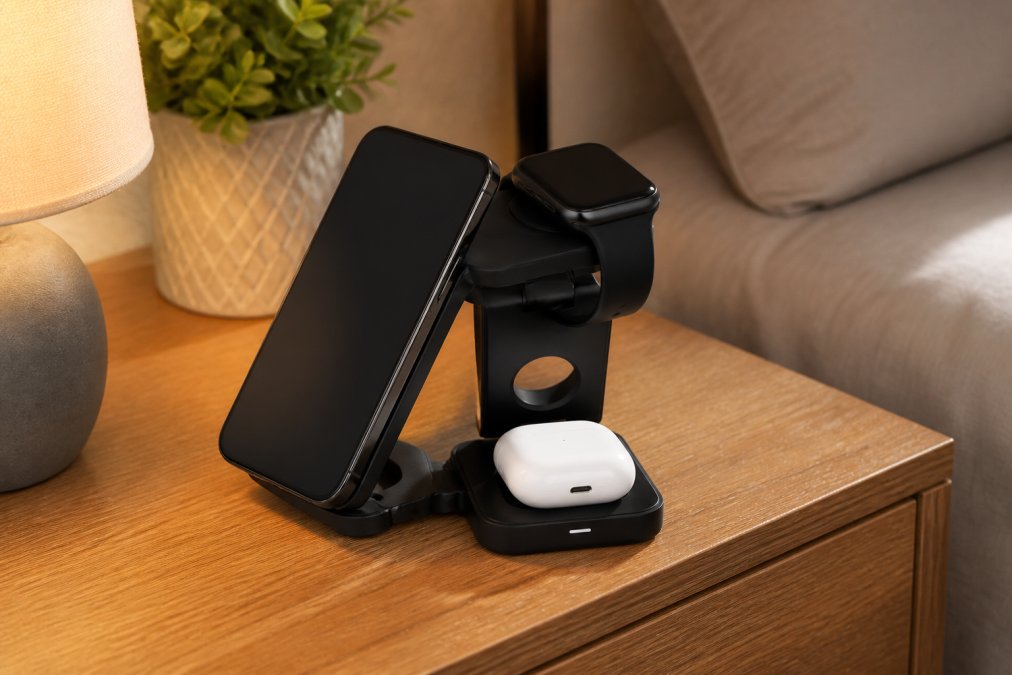
3 IN 1 FOLDABLE WIRELESS CHARGER ($27.30)
The top pick for iPhone users. This 30W magnetic foldable station charges an iPhone, Apple Watch, and AirPods simultaneously using MagSafe-compatible magnetic alignment. Compatible with iPhone 16, 15, 14, and 13 Pro.
The foldable design packs flat for travel and stands upright without a separate stand. Magnetic alignment eliminates the "dead zone" problem where millimeter misplacement cuts charging speed in half.
Best for: Apple ecosystem users wanting a clean, cable-free setup at home and on the road.
Limitation: Apple-first device; Android users without MagSafe won't get magnetic alignment benefits, though standard Qi charging still works.
Add the 3 IN 1 FOLDABLE WIRELESS CHARGER to your cart
3-in-1 Folding Wireless Charger ($26.16)
The adjustable bracket differentiates this option, accommodating different device sizes and angles. It supports simultaneous wireless charging of smartphone, smartwatch, and earbuds with USB-C PD interface and 30W maximum output.
The adjustable design doubles as a phone stand while charging, flat pads can't do this. Watch video or check notifications without picking the device up.
Best for: Mixed-device households or anyone wanting the station to double as a desk stand.
Spec note: USB-C Type-C with PD charging protocol, American plug standard. Output is 2A at 15W per wireless coil.
Add the 3-in-1 Folding Wireless Charger to your cart

3 In 1 LED Fast Wireless Charger Stand ($15.06)
The budget pick that doesn't feel like one. The dual coil design ensures stable fast charging without requiring precise placement, a genuine improvement over single-coil pads where positioning errors kill speed. Package dimensions: 168 x 145 x 30 mm.
What sets this apart is the safety stack: Qi-certified with temperature control, voltage protection, and short-circuit prevention. Ventilation holes provide active cooling during extended sessions. Available in white and black.
Best for: Budget-conscious buyers prioritizing safety certifications who don't need MagSafe alignment.
Add the 3 In 1 LED Fast Wireless Charger Stand to your cart
| Product | Price | Max Output | Key Feature | Best For |
|---|---|---|---|---|
| 3 IN 1 FOLDABLE WIRELESS CHARGER | $27.30 | 30W | MagSafe magnetic alignment | Apple ecosystem users |
| 3-in-1 Folding Wireless Charger | $26.16 | 30W | Adjustable bracket + phone stand | Mixed devices, desk use |
| 3 In 1 LED Fast Wireless Charger Stand | $15.06 | Fast charge | Dual coil + ventilation cooling | Budget buyers, safety-focused |
Cable Management Charging Station: Tangle-Free Setup Tips
Most people buy a cable management station then route cables the same chaotic way as before. The station creates order; your habits destroy it.
What actually works:
- Use the shortest cable that reaches. A 3-foot USB-C cable creates half the tangle of a 6-foot one.
- Route cables through a single exit point. Use a desk grommet, cable clip, or Velcro tie so all cables exit in one direction.
- Label cables at the plug end. Colored heat-shrink bands eliminate confusion with identical plugs.
- Secure the station itself. An anti-slip base prevents sliding when grabbing devices, which pulls cables loose.
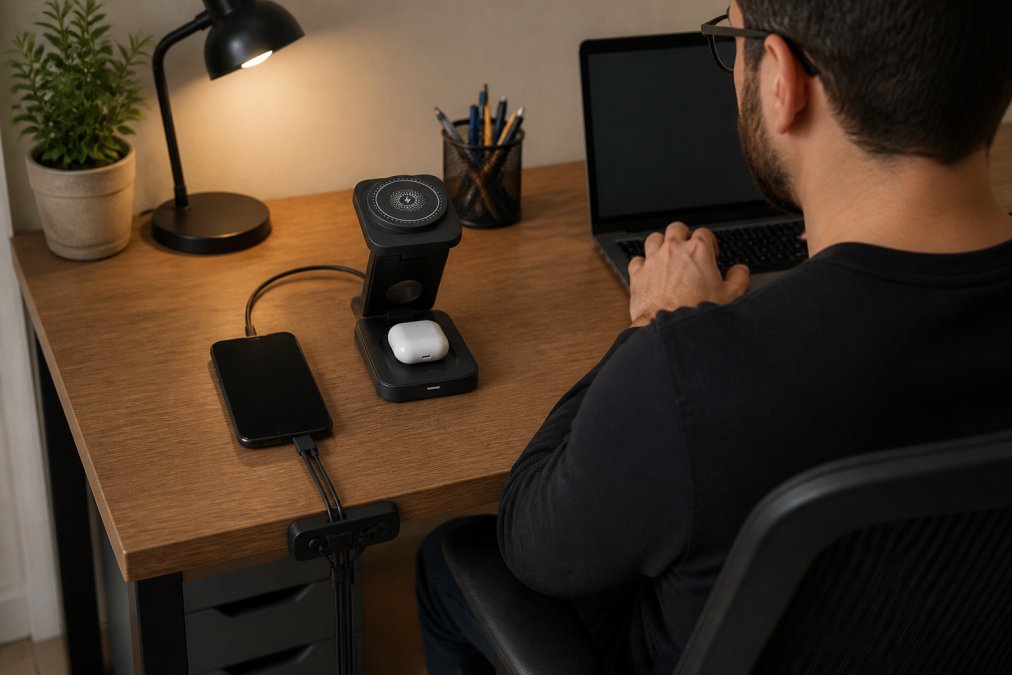
- Go wireless where possible. The foldable 3-in-1 options eliminate cables entirely for phone, watch, and earbuds, the three devices most people grab multiple times daily.
High Wattage Multi-Port Charger: GaN Technology Explained
Traditional silicon chargers have a physical ceiling: more power requires more material, generating more heat and larger form factors. GaN technology breaks this relationship.
GaN (Gallium Nitride) is a semiconductor that switches electrical current faster and more efficiently than silicon, generating less heat at equivalent wattage. A GaN charger delivering 65W-140W fits in a jacket pocket, enough to fast-charge a MacBook, iPhone, and tablet simultaneously.
The efficiency advantage matters for two reasons. First, it extends charger lifespan. Second, it reduces heat transferred to devices during charging, and heat accelerates lithium battery degradation.
For a space-saving station handling laptops alongside phones and earbuds, GaN is the technology to prioritize.
Wireless vs. Wired Multi Device Charging: Which Fits Your Setup?
Wireless charging stations held 42.3% market share in 2025, according to Dataintelo's 2026 market research report. But market share doesn't mean wireless is automatically right for every setup.
Wireless charging is better when:
- You charge the same devices in the same spot daily (phone, watch, earbuds)
- Cable clutter is your primary frustration
- You want to grab and replace devices quickly
- Your devices support Qi or Qi2/MagSafe
Wired charging is better when:
- You need to charge tablets or laptops (wireless can't deliver the wattage)
- You want fastest possible speed, wired USB-C PD at 45W+ outpaces wireless
- You're charging devices from multiple ecosystems with inconsistent Qi support
The most practical answer: a hybrid setup. Use a 3-in-1 foldable wireless station for devices you touch constantly, and keep a single high-wattage USB-C port available for tablets or laptops.
Heat Dissipation and Thermal Management: What Most Buyers Overlook
Heat is the silent killer of chargers and device batteries. Most buyers compare ports and wattage; almost nobody reads thermal management specs. This determines whether your charger lasts two years or five.
Three heat sources affect multi-device charging stations:
- Power conversion heat: AC-to-DC conversion is never 100% efficient; lost energy becomes heat. GaN chargers convert more efficiently, producing less heat.
- Simultaneous charging load: Running three wireless coils at full output generates more heat than single-device charging. Stations with ventilation holes or thermal cutoffs manage this; cheap stations run hot continuously.
- Device-to-charger heat transfer: Wireless charging generates heat at the coil interface. Devices throttle charging speed when internal temperature rises.
Overnight charging accelerates battery aging. Charging to 80% before bed rather than leaving devices on the pad all night requires either a smart charger with scheduled charging or manual discipline.
The Jackie's Attic LED Fast Wireless Charger Stand addresses this directly: its dual coil design with built-in temperature control and ventilation holes provides passive cooling most units at this price skip.
Quick Comparison: Space Saving Charging Stations at a Glance
| Feature | 3 IN 1 FOLDABLE ($27.30) | 3-in-1 FOLDING ($26.16) | LED FAST STAND ($15.06) |
|---|---|---|---|
| Max output | 30W | 30W | Fast charge |
| Wireless coils | 3 | 3 | Dual coil |
| MagSafe compatible | Yes | Magnetic suction | No |
| Adjustable bracket | No | Yes | No |
| Temperature control | Standard | Standard | Yes (built-in) |
| Ventilation cooling | No | No | Yes |
| Interface | USB-C | USB-C PD | USB-C |
| Foldable | Yes | Yes | Yes |
| Best use case | Apple ecosystem | Mixed devices / desk stand | Budget / safety-first |
| Price | $27.30 | $26.16 | $15.06 |
All three Jackie's Attic options represent the space-saving category well, covering different priorities at similar price points. According to Fortune Business Insights' Wireless Charging Market report, the global wireless charging market was valued at $37.28 billion in 2025 and is projected to reach $237.03 billion by 2034, with the U.S. market alone projected to reach $12.29 billion by 2026. The technology is becoming standard infrastructure.
Choosing the right space-saving multi-device charging station comes down to knowing your device ecosystem, understanding wattage requirements, and not skipping safety certifications. Jackie's Attic offers three foldable 3-in-1 wireless options covering the full range: magnetic MagSafe alignment for Apple users, an adjustable bracket for mixed-device households, and a dual-coil safety-focused option for budget-conscious buyers. Add any to your cart and replace cable tangle with one compact, organized charging setup that fits your space.
Frequently Asked Questions
What is the best wireless charging station for multiple devices in a small space?
A 3-in-1 foldable wireless charger is the most space-efficient option for multi device charging at home. Foldable designs collapse flat when not in use and fold out to charge a phone, smartwatch, and earbuds simultaneously. Jackie's Attic carries two foldable 3-in-1 models starting at $26.16, both supporting 30W output with USB-C Power Delivery and magnetic alignment for compatible iPhones.
How do I choose a charging station that won't clutter my desk?
Look for a compact footprint, built-in cable management, and a foldable or vertical design. Stations with a single USB-C input cable reduce cord sprawl significantly. GaN-based chargers are physically smaller than traditional AC adapters at the same wattage, which helps on tight desks. An anti-slip base keeps the station in place without requiring extra space for anchoring accessories.
Is wireless charging slower than wired for multi device charging stations?
Wireless pads typically deliver 5W to 15W per device, while wired USB-C ports with Power Delivery can push 45W to 100W to a single device. For phones and earbuds the speed gap is minor in daily use, but laptops and tablets charge noticeably faster over a wired connection. A hybrid station combining wireless pads for phones with wired USB-C ports for larger devices gives you the best of both.
Are multi device charging stations safe to leave plugged in overnight?
Qi-certified stations with over-current protection, voltage regulation, and short-circuit prevention are designed for unattended use. The main concern is heat buildup when multiple devices charge simultaneously, which can accelerate battery aging over time. Choose a station with ventilation holes or active thermal regulation, and avoid stacking devices directly on top of each other while charging.
What wattage do I need for a high wattage multi-port charger that handles a laptop and phone at the same time?
A laptop typically needs 45W to 65W on its own. Add a phone at 20W and you need at least 90W total output from the charger. GaN chargers in the 100W to 140W range handle this comfortably while maintaining a compact footprint. Always check the charger's power distribution spec: some units reduce per-port wattage when multiple ports are active simultaneously.
This article was written using GrandRanker


