


Table of Contents
- Why Your Kitchen Faucet Splashes
- How to Clean Faucet Aerator to Stop Splashing
- Best Faucet Aerator for Splashing: Laminar Flow vs. Standard
- Adjust Kitchen Faucet Water Pressure
- Optimize Faucet Height and Spout Reach
- How to Fix Splashing Kitchen Faucet: Troubleshooting Spray Head Issues
- Upgrade Your Setup: Faucet Extender Solution
- Frequently Asked Questions
Last Updated: September 3, 2026
Why Your Kitchen Faucet Splashes
A splashing kitchen faucet is wasteful and usually fixable with simple adjustments. According to Hippo Insurance's 2024 Homeowner Preparedness Report, 66% of homeowners experience a summer plumbing issue, with faucet problems ranking among the most common complaints. Most splashing stems from one of three root causes: a clogged aerator, mismatched faucet geometry, or high water pressure.
Water splashes when the stream hits the basin at the wrong angle, velocity, or flow pattern. The aerator, the small mesh screen at the faucet's tip, mixes air into water flow. When mineral deposits clog it, pressure increases and water direction becomes unpredictable. Alternatively, your faucet height or spout reach may not match your sink's depth, or water pressure itself may be too high, creating turbulent flow that rebounds. Understanding which cause applies is the first step toward fixing the problem.
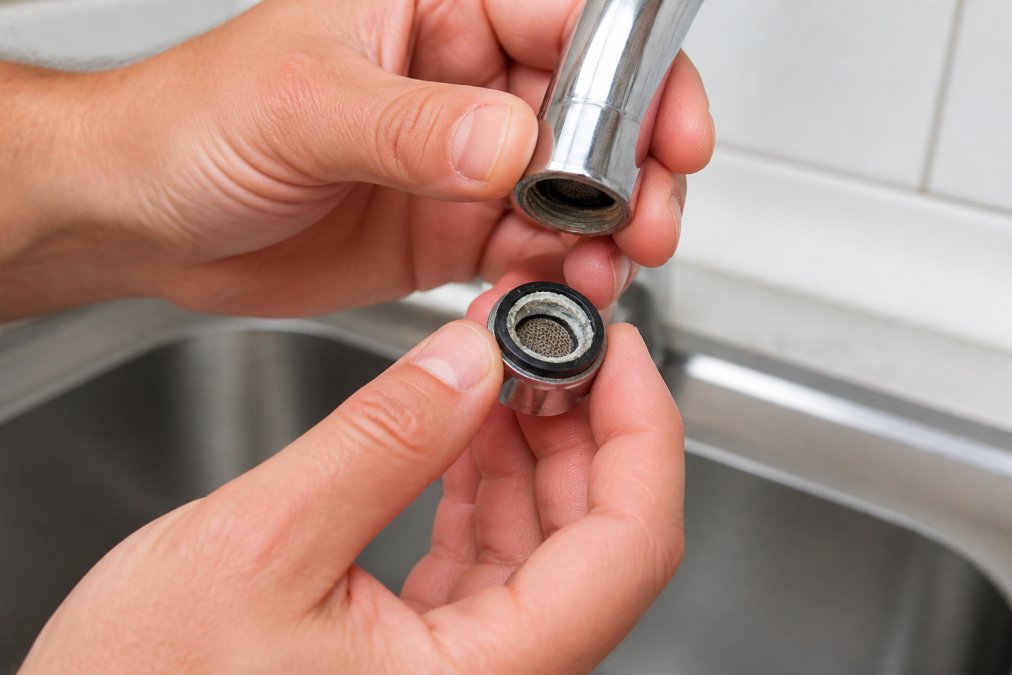
How to Clean Faucet Aerator to Stop Splashing
Cleaning your faucet aerator is the fastest and cheapest fix for splashing. Most aerators unscrew by hand or with a simple wrench, and the entire process takes under five minutes.
Step 1: Unscrew the Aerator
Locate the aerator at the faucet spout tip and grip it firmly, turning counterclockwise. Most unscrew by hand; if stuck, wrap a cloth around it for better grip or use a small adjustable wrench. Avoid excessive force, which can crack the plastic housing. Set the internal components, mesh screen, rubber washer, and flow restrictor, in order on a clean surface for reassembly.
Step 2: Rinse and Soak
Rinse the aerator screen under warm running water to dislodge loose debris. If mineral buildup is visible, soak the aerator in white vinegar for 15-30 minutes. Vinegar dissolves calcium deposits that restrict flow and cause turbulent spray. After soaking, use an old toothbrush to gently scrub the screen, working from outside in. Rinse thoroughly until water flows freely through every opening.
Step 3: Reassemble and Test
Reassemble in reverse order: screen, rubber washer, flow restrictor (if present), then housing. Screw the aerator back onto the faucet tip until snug, do not over-tighten. Turn on the water and observe the stream. A cleaned aerator should produce smooth, coherent flow without splashing. If splashing persists, move to the next solution.
Best Faucet Aerator for Splashing: Laminar Flow vs. Standard
Not all aerators are created equal. The difference between standard and laminar flow aerators directly affects splashing.
Standard aerators mix air bubbles into the water stream, increasing perceived flow volume while reducing consumption. However, air pockets break up the water stream, causing it to spread and splash. According to Supply House Times' 2005 study, 71% of faucet users own standard aerators, and they're more likely to experience splashing.
Laminar flow aerators align water into focused, parallel streams with minimal air mixing. The water flows as thin, coherent jets that travel farther and hit the sink more directly, eliminating turbulent spray. Research from Jaquar Global's 2024 analysis confirms that laminar flow aerators limit splashing by creating focused streams.
For a splashing kitchen faucet, laminar flow is superior. The trade-off: laminar aerators deliver less perceived volume and cost slightly more, typically $8-20 versus $3-8 for standard aerators. If compatible, upgrading to a laminar aerator solves most splashing problems permanently.
To find the right replacement, measure your faucet's threaded connection at the tip. Most kitchen faucets use 15/16-inch or 55/64-inch threads. Jackie's Attic's 1080° Rotatable Faucet Extender ($16.92) offers an alternative approach, extending spout reach and allowing precise angle control, which also reduces splashing.

Adjust Kitchen Faucet Water Pressure
High water pressure exacerbates splashing by forcing water to rebound harder off the sink basin. However, pressure is often not the root cause. Before adjusting, diagnose whether it's actually your problem.
How to Diagnose High Pressure as the Culprit
High pressure typically produces these symptoms:
- Water sprays outward in a wide cone rather than flowing coherently
- Splashing occurs even with a clean aerator and proper faucet height
- Water pressure feels noticeably stronger at your kitchen sink than at other faucets
- The aerator produces a loud, rushing sound
If your faucet produces a smooth, quiet stream that splashes only when hitting the sink basin at certain angles, pressure is likely not your issue. Federal standards cap residential water pressure at 80 pounds per square inch (PSI). Most homes operate at 40-60 PSI. If your pressure exceeds 80 PSI, your water utility or home's pressure regulator is the issue.
Adjusting the Shut-Off Valve
If high pressure is confirmed, locate the shut-off valve underneath your sink where the water supply line connects. Turn it slightly counterclockwise, a quarter turn at a time. After each adjustment, observe the stream. You're aiming for reduced splashing without sacrificing usable flow for filling pots or washing dishes. Most kitchen tasks require 1.5-2.2 gallons per minute (GPM).
Optimize Faucet Height and Spout Reach
The physical geometry of your faucet, how high it sits above the sink and how far the spout extends, directly determines whether water splashes.
Measuring Faucet Height and Spout Reach
Faucet height: Measure from the sink rim to the lowest point of the spout when water runs. Ideal range is 8-12 inches. Higher than 12 inches, water spreads before hitting the basin. Lower than 8 inches, you may struggle filling tall pots.
Spout reach: Measure horizontally from the back edge of the sink basin to the spout tip. Ideal range is 4-6 inches. More than 6 inches, water arcs outward and splashes backward. Less than 4 inches, you lose functionality for large cookware.
How Sink Depth Amplifies or Reduces Splashing
Sink depth is critical to understanding splashing. Shallow sinks (less than 6 inches deep) provide minimal deceleration space, so water rebounds harder and splashes more. Deep sinks (8+ inches) allow water to lose velocity naturally, reducing splashing even with a standard aerator. Measure your sink depth at its deepest point. If shallower than 6 inches, splashing is partly unavoidable with any faucet. Upgrading to a laminar flow aerator or using a faucet extender becomes more important.
Sink Material and Splash Rebound
Stainless steel sinks are rigid and highly reflective. Water splashing against them rebounds sharply and produces loud, metallic noise.
Fireclay and ceramic sinks are porous and absorb impact energy, reducing rebound and noise.
Cast iron sinks (enameled) fall between the two: rigid but with dampening coating.
If you have a stainless steel sink, the material amplifies splashing. Upgrading your aerator to laminar flow or adjusting faucet height becomes more critical.
Repositioning or Replacing Your Faucet
If your faucet's height or reach is mismatched to your sink, you have three options:
Option 1: Reposition the supply lines (if your setup allows). This requires basic plumbing knowledge and is not recommended for renters.
Option 2: Replace the faucet with a model designed for your sink size. Prioritize faucets with shorter spouts and lower arcs for shallow sinks, or "high-arc" for deep basins.
Option 3: Use a faucet extender (fastest, reversible solution). A rotatable faucet extender attaches to your existing spout and adds reach, height adjustment, and directional control. Extenders cost $15-25, install in under a minute, and are ideal for renters.
How to Fix Splashing Kitchen Faucet: Troubleshooting Spray Head Issues
If your faucet has a pull-down or pull-out spray head, splashing often stems from the spray head mechanism. Check whether water exits both the main spout and spray head simultaneously. If so, the diverter valve is stuck or worn and requires professional repair.
Inspect the spray head's connection point and ensure it's secure. If the counterweight is loose or missing, the spray head hangs awkwardly, directing water at odd angles. Replacement spray heads cost $15-40 and swap in easily.
Finally, check the spray head's nozzle for clogs. Hard water deposits can block spray holes, forcing water through remaining openings at higher pressure. Soak the spray head in vinegar for 15 minutes, then use a thin wire to clear each hole. This simple maintenance often restores proper spray function.
Upgrade Your Setup: Faucet Extender Solution
If your faucet's spout reach or height is fundamentally mismatched to your sink, a faucet extender provides a flexible solution without replacing the entire fixture. Jackie's Attic's 1080° Rotatable Faucet Extender ($16.92) solves splashing by letting you angle the water stream precisely. The 1080-degree rotation means you can position the stream from any angle, eliminating splashing entirely. Extenders install in under a minute and are reversible if you need to remove them.
Fixing a splashing kitchen faucet doesn't require expensive repairs or professional help. Start with the simplest solution, cleaning your aerator, and progress through pressure adjustment, geometry optimization, and hardware upgrades only if needed. Most splashing problems resolve with a five-minute aerator cleaning or a $15-20 laminar flow replacement. For persistent issues, Jackie's Attic's rotatable faucet extender gives you directional control that transforms how water flows into your sink.
=== FAQ ANSWERS (audit these too, same rules) ===
[1] Q: Why is my kitchen faucet splashing so much? A: Kitchen faucet splashing usually stems from a clogged aerator filled with mineral deposits or debris, misaligned water flow, or water pressure that's too high. A dirty aerator restricts water flow unevenly, causing turbulence and splashing. Old and worn faucet washers and gaskets frequently cause leaks and irregular flow patterns. Cleaning the aerator or adjusting your water pressure typically resolves the issue.
[2] Q: How do I clean a clogged faucet aerator? A: Unscrew the aerator from the faucet tip (turn counterclockwise). Soak it in white vinegar for 30 minutes to dissolve mineral buildup and calcium deposits. Rinse thoroughly under running water, then use a soft brush to clean the mesh screen. Reassemble and test. This simple maintenance task takes about 10 minutes and eliminates most splashing caused by sediment or debris blocking the water stream.
[3] Q: What's the difference between laminar and aerated flow aerators? A: Laminar flow aerators align water into focused, organized streams that limit splashing by directing water straight down into the sink. Aerated aerators infuse air into the water for a fuller feel while using less water, but they can increase turbulence and splashing if the aerator is clogged. For splashing problems, laminar flow aerators are the best choice because they create a more controlled, concentrated water stream with minimal splash back.
[4] Q: Can I fix splashing by adjusting water pressure? A: Yes. High water pressure increases velocity and turbulence, causing more splashing. Most kitchen faucets have a shut-off valve under the sink. Turn it slightly counterclockwise to reduce flow rate. Start with small adjustments and test the water stream. You want enough pressure for cleaning efficiency but not so much that water bounces off the sink basin. Lower pressure also reduces water waste, a dripping faucet can waste over 3,000 gallons per year.
Frequently Asked Questions
Why is my kitchen faucet splashing so much?
Kitchen faucet splashing usually stems from a clogged aerator filled with mineral deposits or debris, misaligned water flow, or water pressure that's too high. A dirty aerator restricts water flow unevenly, causing turbulence and splashing. Old and worn faucet washers and gaskets frequently cause leaks and irregular flow patterns. Cleaning the aerator or adjusting your water pressure typically resolves the issue.
How do I clean a clogged faucet aerator?
Unscrew the aerator from the faucet tip (turn counterclockwise). Soak it in white vinegar for 30 minutes to dissolve mineral buildup and calcium deposits. Rinse thoroughly under running water, then use a soft brush to clean the mesh screen. Reassemble and test. This simple maintenance task takes about 10 minutes and eliminates most splashing caused by sediment or debris blocking the water stream.
What's the difference between laminar and aerated flow aerators?
Laminar flow aerators align water into focused, organized streams that limit splashing by directing water straight down into the sink. Aerated aerators infuse air into the water for a fuller feel while using less water, but they can increase turbulence and splashing if the aerator is clogged. For splashing problems, laminar flow aerators are the best choice because they create a more controlled, concentrated water stream with minimal splash back.
Can I fix splashing by adjusting water pressure?
Yes. High water pressure increases velocity and turbulence, causing more splashing. Most kitchen faucets have a shut-off valve under the sink. Turn it slightly counterclockwise to reduce flow rate. Start with small adjustments and test the water stream. You want enough pressure for cleaning efficiency but not so much that water bounces off the sink basin. Lower pressure also reduces water waste, a dripping faucet can waste over 3,000 gallons per year.
This article was written using GrandRanker


