


Last Updated: October 31, 2026
Quick Summary
The most eco friendly materials for desk charging accessories are solid bamboo and clearly specified recycled plastic, because both are renewable or recycled and can last with daily use. Check for a stated recycled-content percentage or forestry certification before trusting a green label. Repairability and warranty length also show whether a charger will last.
- Solid bamboo looks natural and resists everyday desk wear, but it is sensitive to moisture and prolonged heat.
- Recycled plastic is durable, but quality varies by manufacturer, so build quality matters more than the label.
- Ask for a specific recycled-content percentage; a vague recycled claim cannot be verified.
- Mixed-material assemblies are rarely accepted in curbside recycling, so check local electronics recycling options.
- A longer warranty and replaceable cables are practical signs that a charger will last.
Table of Contents
- Bamboo Wireless Charger Pads: What Solid Bamboo and Bamboo Blends Actually Offer
- Recycled Plastics and Recycled Desk Accessories: Durability and Trade-offs
- Material-by-Material Comparison: Bamboo, Recycled Plastic, Cork, and Reclaimed Wood
- Choosing an Eco-Friendly Charging Station Without Sacrificing Performance or Safety
- How to Verify Environmental Claims and Certifications
- Pick Your Next Desk Charger: A Short Buying Checklist
- Frequently Asked Questions
Most desk chargers end up in the trash within a few years, and the materials are a big reason why. If you care about eco friendly materials for desk charging accessories, the shell, cable, and packaging matter as much as the charging speed. Here is what to look for before you buy.
A desk charging accessory is any small device that powers phones, earbuds, or watches from a tabletop, such as a wireless pad, a multi-device stand, or a cable organizer. Its materials shape how long it lasts, how much waste it creates, and how it looks next to your laptop.
Materials decide three things:
- Durability: Thicker shells and sturdy hinges survive daily desk use.
- Repairability: Replaceable cables and parts keep a charger useful longer.
- End-of-life impact: Recycled or natural materials can reduce what ends up in landfill.
Charging accessories often sell on design alone, so claims about "green" materials can be vague. A good rule: ask what the product is made of and how long it is designed to last. Brands that answer clearly tend to be easier to trust.
Bamboo Wireless Charger Pads: What Solid Bamboo and Bamboo Blends Actually Offer
Bamboo is a popular choice for wireless charging pads because it is a renewable material with a natural look. Bamboo charging pads are often sold as solid bamboo or as bamboo blended with plastic. The difference matters. A solid bamboo pad looks more natural, while a blend may add strength and water resistance.
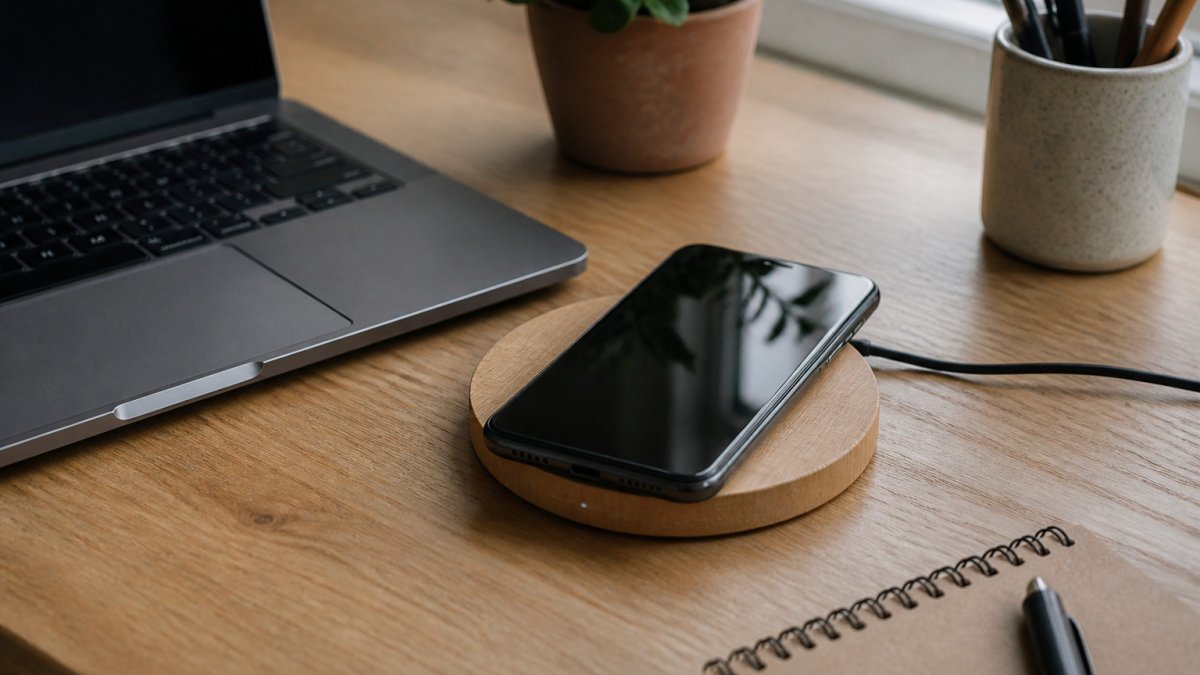
Wood-based materials can warp or crack with heat and humidity, so check the product details before buying. A bamboo pad on a sunny desk may behave differently than one kept in a humid room.
When you shop, compare:
- Whether the pad is solid bamboo or a bamboo blend
- The stated charging standard (look for Qi compatibility)
- Whether the cable is included and how it is attached
Our pick for a multi-device desk setup is the 3-in-1 Folding Wireless Charger, which charges a phone, smartwatch, and earbuds at once. Its folding design helps on a crowded desk.

Recycled Plastics and Recycled Desk Accessories: Durability and Trade-offs
Recycled plastic is another common material in desk accessories. Recycled content can keep plastic out of landfills, but it is not automatically better.
The trade-off is consistency. Recycled materials may vary in color and finish between batches, and a product's lifespan depends on build quality more than the label. Look for specific details, like "recycled plastic shell" with a clear description, rather than a general "eco" claim.
Recycled-material chargers often use durable cables and sturdy housings. Before buying, check the listing for stated materials and warranty terms.
Material-by-Material Comparison: Bamboo, Recycled Plastic, Cork, and Reclaimed Wood
Most roundups treat "sustainable" as a single category. It is not. Two chargers with the same eco label can have very different sourcing, durability, repairability, and end-of-life paths. Use this comparison to judge materials on the criteria that actually affect a desk charger's footprint.
Bamboo
- Sourcing: A fast-growing grass that can be harvested without replanting, which is why it is marketed as renewable. Look for FSC certification on the product or packaging to confirm responsible forestry management.
- Durability: Solid bamboo resists everyday desk wear but is sensitive to moisture and prolonged heat. A bamboo pad left in direct sun or near a humidifier can warp or develop surface cracks.
- Repairability: Usually a single-piece shell, so repair means replacement. Check whether the charging module is accessible or sealed.
- End-of-life: Untreated solid bamboo can often be composted or broken down, but blended bamboo-plastic composites cannot be separated and typically go to landfill.
Recycled plastic
- Sourcing: Made from post-consumer or post-industrial plastic. The claim is only as good as its specificity, look for a stated recycled-content percentage rather than a vague "recycled" label.
- Durability: Generally water resistant and impact tolerant. Quality varies widely by manufacturer, so build quality matters more than the recycled label.
- Repairability: Housings are often screwed or snapped together, which can make cable or module replacement possible. Ask whether replacement parts are sold.
- End-of-life: Recyclable in principle, but mixed-material assemblies (plastic plus metal plus electronics) are rarely accepted in curbside recycling. Check local electronics recycling options.
Cork
- Sourcing: Harvested from cork oak bark without felling the tree, so it is renewable on a multi-year cycle. Certification is less standardized than forestry programs, so ask the brand for sourcing details.
- Durability: Lightweight and naturally soft, but less rigid than bamboo or plastic. It suits a stable desk surface and is less ideal for travel or heavy daily handling.
- Repairability: Often laminated to a backing, which makes separation difficult. Treat it as a wear item.
- End-of-life: Natural cork can biodegrade, but adhesives and backing layers complicate disposal.
Reclaimed wood
- Sourcing: Reuses wood from older structures or offcuts, which avoids new timber harvest. Grain and dimensions vary, so no two pieces match.
- Durability: Heavier and sturdy, but sensitive to humidity changes like bamboo. Sealed finishes help.
- Repairability: Often assembled with screws, which can allow partial disassembly. Check for accessible fasteners.
- End-of-life: Untreated wood can be composted or burned in some jurisdictions; finished or glued assemblies usually cannot.
The table below sums up how each material compares on sourcing, durability, and end-of-life, as covered in the sections above.
| Material | Durability | End-of-life |
|---|---|---|
| Bamboo | Resists daily wear; sensitive to moisture and prolonged heat | Untreated solid bamboo can be composted; blends typically go to landfill |
| Recycled plastic | Generally water resistant and impact tolerant; quality varies | Recyclable in principle; mixed-material assemblies are rarely accepted curbside |
| Cork | Lightweight and soft; less rigid than bamboo or plastic | Natural cork can biodegrade; adhesives and backing complicate disposal |
| Reclaimed wood | Sturdy but sensitive to humidity changes; sealed finishes help | Untreated wood can be composted; finished or glued assemblies usually cannot |
Choosing an Eco-Friendly Charging Station Without Sacrificing Performance or Safety
An eco-friendly charging station should still charge safely and quickly. Sustainability and performance do not have to conflict.
Watch for these safety basics:
3 In 1 LED Fast Wireless Charger Stand Foldable Charging Station →
- Built-in protection against overheating and short circuits
- A recognized charging standard, such as Qi for wireless charging
- Ventilation so the charger can release heat
Our pick here is the 3 In 1 LED Fast Wireless Charger Stand Foldable Charging Station. Its listing describes temperature control, voltage protection, and short-circuit prevention, plus ventilation holes for cooling.

Cheap charging cables are a common safety concern. If a cable feels flimsy or gets hot, replace it. Use the cable the charger came with, or one from a reputable maker.
How to Verify Environmental Claims and Certifications
Words like "eco-friendly" and "sustainable" have no fixed legal meaning on most products. The Federal Trade Commission's Green Guides set out how marketers should support environmental claims (the FTC). FTC Green Guides on environmental marketing claims
Use this four-part check before you trust a claim.
1. Recycled-content claims
Look for a specific percentage and what it refers to, the shell, the packaging, or the whole product. "Made with recycled plastic" without a number is not verifiable. A credible listing states something like "shell contains 50% post-consumer recycled plastic" and identifies which component.
2. Responsible forestry and material certifications
Certifications differ in what they cover, so read what each one actually measures:
A logo alone is not proof. Check the certifying body's public database for the product or company name.
3. Packaging claims
Packaging is often where green claims are weakest. Check whether the box is labeled recyclable, made from recycled fiber, or plastic-free, and whether that matches your local recycling rules. "Recyclable" does not mean your curbside program accepts it.
4. Longevity and warranty as evidence
A longer warranty is a practical signal that the maker expects the product to last. Read the terms: how long coverage lasts, what it covers, and whether replacement parts or cables are sold separately. A charger designed for a replaceable cable wastes less than a sealed unit that must be discarded when the cable fails.
When you compare listings, keep a simple record: material, recycled-content percentage, certification name and code, packaging description, and warranty length. That record is more useful than any single green badge.
Pick Your Next Desk Charger: A Short Buying Checklist
Use this checklist before you buy:
- Materials are named clearly (bamboo, recycled plastic, and so on)
- Charging standard is listed (Qi for wireless)
- Safety features like overheat and short-circuit protection are mentioned
- Cable quality and replacement options are clear
- Warranty terms are easy to find
- Footprint fits your desk
Shopping around is smart, and the checklist above works for any brand. When you are ready, browse the Jackie's Attic collection to compare the options side by side.
Frequently Asked Questions
What materials are used in eco-friendly desk charging accessories?
Common materials include bamboo, recycled plastics, recycled nylon braiding, and reclaimed or solid wood. Check each product listing for the exact material breakdown, since 'eco-friendly' on its own does not tell you what the product is made of.
Is bamboo a good material for a wireless charging pad?
Charging performance depends mostly on the internal coil and electronics, not the outer shell, so a bamboo pad should still meet Qi certification and include temperature and short-circuit protection. Look at the electronics specifications, not only the outer material, before you buy.
Are recycled plastics durable enough for charging accessories?
Look for a stated warranty and read reviews that mention months of use rather than first-week impressions.
What should I look for in a sustainable desk charging station?
Start with the material list and check whether the product uses recycled or renewable content. Confirm it has safety features such as temperature control and overcurrent protection, and check whether it is Qi certified. Finally, look at packaging and replaceable parts, since a charger that can be repaired or whose cable can be swapped usually lasts longer.


