


Table of Contents
- Why Coffee Goes Cold So Fast in the Car
- How to Preheat a Coffee Thermos the Right Way
- Best Vacuum Insulated Travel Mugs for Commuters
- Step-by-Step: How to Keep Coffee Hot During Long Commutes
- Lid Seal, Fill Level, and the Habits That Kill Heat Retention
- Maintaining Coffee Flavor During Long Commutes
- Vehicle-Specific Heating Solutions to Keep Coffee Hot
- Conclusion
Last Updated: August 24, 2026
Why Coffee Goes Cold So Fast in the Car
According to the National Coffee Association's 2026 National Coffee Data Trends report, 85% of past-day coffee drinkers made their coffee at home, the highest share recorded since 2012. That means millions of people are pouring fresh coffee into whatever container they have, heading out the door, and watching their drink go lukewarm before they hit the highway.
Here at Jackie's Attic, we hear this complaint constantly. You brew a great cup, you're ten minutes into your commute, and the coffee is already disappointing. The good news: heat loss in a car is predictable, and once you understand it, you can fight it.
Below, we'll walk through exactly how to keep coffee hot during long commutes, the physics, the habits, and the gear that actually works.
Conduction, Convection, and Heat Dissipation Explained Simply
Thermal equilibrium is the enemy. Every hot object wants to reach the same temperature as its surroundings, and your coffee is no exception. Three mechanisms drive that heat dissipation:
- Conduction transfers heat directly through solid materials. A ceramic mug sitting on a cold car seat loses heat through its base almost immediately.
- Convection moves heat through the air. Cold air circulating around your mug pulls warmth away from the surface continuously.
- Radiation emits heat as infrared energy. This matters less for a covered mug but becomes significant in a cold car interior.
The practical implication: every material touching your container, and every air gap around it, is either helping or hurting your heat retention.
How Ambient Temperature Speeds Up Heat Loss
This is the angle most guides skip entirely. The colder the environment around your container, the steeper the temperature gradient between your coffee and the air, and the faster heat transfer happens. A travel mug in a 30°F car on a winter morning will lose heat significantly faster than the same mug in a 70°F office.
Car interiors can drop well below freezing overnight. If you get in, start driving, and the cabin hasn't warmed up yet, your insulated mug is fighting against both a cold car and cold ambient air simultaneously. Pre-warming your vehicle before loading your coffee makes a measurable difference in how long that drink stays hot.
How to Preheat a Coffee Thermos the Right Way
Preheating is the single most underused technique for keeping coffee hot, and it costs nothing. Most people skip it because it feels like an extra step. It isn't, it's the step that makes every other step work better.
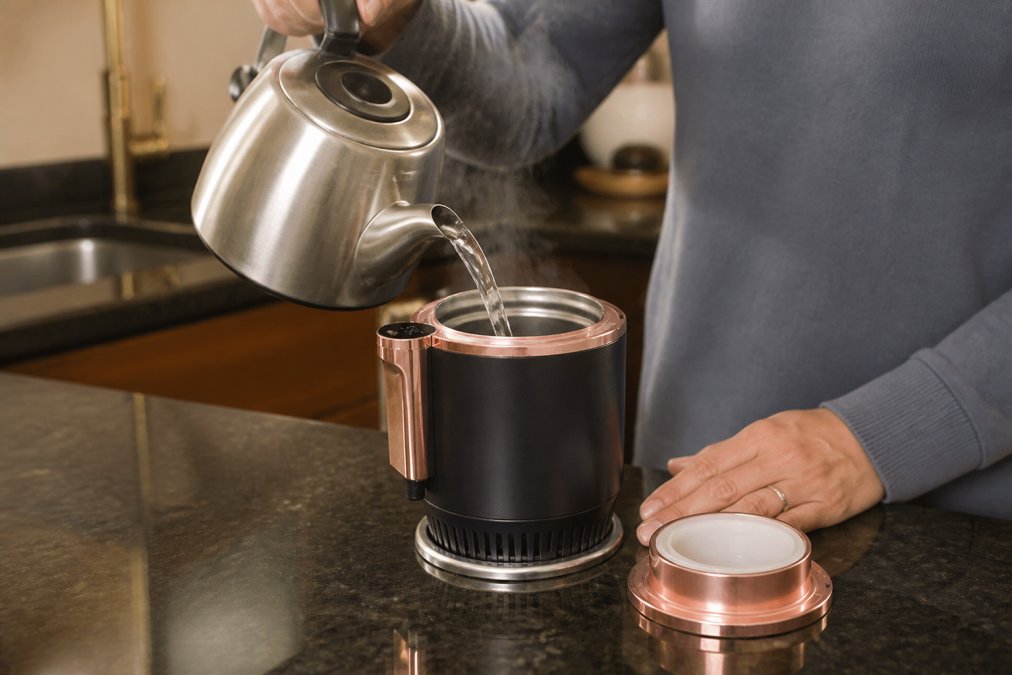
A cold container acts as a heat sink. The moment you pour hot coffee into a room-temperature thermos, the metal walls absorb heat from the liquid before the lid is even on. Preheating a mug or thermos with hot water for 60 seconds can add 20 to 30 minutes of effective heat retention. For a 45-minute commute, that's the difference between a hot drink and a tepid one.
How to preheat correctly:
- Fill your thermos with the hottest tap water available, or boiling water from a kettle.
- Seal the lid and let it sit for at least 60 seconds, 2 minutes is better.
- Dump the water right before pouring your coffee.
- Pour immediately. Don't let the warmed container sit empty.
- Fill to capacity (more on why this matters below) and seal.
The whole process takes under three minutes. If you're using a quality vacuum-insulated container, this one habit can extend your effective heat window by a meaningful margin.
Best Vacuum Insulated Travel Mugs for Commuters
Double-wall vacuum insulation is the gold standard for passive heat retention. Modern thermoses with this technology can maintain coffee heat for 8 to 24 hours, according to research on insulation performance. That range is wide because build quality, lid design, and container size all affect actual performance.
What to Look for in a Double-Wall Stainless Steel Mug
Stainless steel with a vacuum-sealed air gap between two walls eliminates both conduction and convection as heat loss pathways. The air gap, essentially a thermal barrier, prevents heat from transferring through the container walls. The result is dramatically better temperature stability than ceramic, glass, or single-wall plastic.
| Feature | Why It Matters | What to Look For |
|---|---|---|
| Double-wall vacuum | Eliminates conduction and convection loss | Confirmed vacuum seal, not just double-wall |
| Lid seal quality | Prevents convective heat loss at the top | Gasket seal, lockable mechanism |
| Container size | More liquid = more thermal mass | 16 oz minimum for commutes |
| Cup holder fit | Usability in the car | Tapered base, under 3.5" diameter |
| Lid opening frequency | Every opening loses heat | Wide-mouth with sip lid, not screw-off cap |
Testing by Consumer Reports' 2026 insulated cup evaluation found that a 16 oz stainless steel mug kept drinks hot for more than 13 hours and fit easily into most car cup holders. The same testing highlighted a thermos with a tapered shape and tea hook as a strong performer for commuters specifically.

The thing most reviews miss: lid construction matters as much as wall insulation. A lid with a poor gasket seal will vent heat constantly, negating the benefits of even the best vacuum insulation. Press-fit lids with locking mechanisms outperform screw-top lids for heat retention during commutes.
Active Heating: When Passive Insulation Isn't Enough
Passive insulation slows heat loss, it doesn't replace lost heat. For commutes exceeding two to three hours, or for drivers who leave their coffee sitting for extended periods, active heating solutions close the gap.
Self-heating travel mugs can maintain coffee at a chosen temperature range for several hours on a full charge. The Jackie's Attic Smart Digital Thermal Bottle ($9.33) is a 450ml double-layered stainless steel vacuum flask with a built-in digital temperature display, showing real-time beverage temperature so you know exactly what you're drinking. It's designed for commuters, travel, and daily use, and the digital readout removes the guesswork entirely.

Step-by-Step: How to Keep Coffee Hot During Long Commutes
The most effective approach combines container choice, preparation habits, and in-car technique. Here's the complete sequence:
- Pre-warm your car. Start the engine and let the cabin heat up before loading your coffee. A cold interior accelerates heat loss from the moment you place your mug in the cup holder.
- Preheat your thermos. Fill with boiling water for 60 to 120 seconds, then empty immediately before pouring coffee.
- Brew hot and pour immediately. Don't let coffee sit in the pot. Brew directly into the preheated container when possible.
- Fill to capacity. A full container has less air space above the liquid, reducing convective heat loss inside the mug.
- Seal the lid completely. Check that the gasket is seated and any locking mechanism is engaged.
- Avoid opening the lid unnecessarily. Every time you open the lid, you release a burst of heat and allow cold air in. Sip strategically.
- Use a cup holder insulator or active warmer for long hauls. If your commute exceeds 90 minutes, passive insulation alone may not be enough.
- Keep the mug out of direct sunlight in summer. Counterintuitively, UV exposure and greenhouse heat inside a car can cause uneven temperature distribution and affect flavor.
Lid Seal, Fill Level, and the Habits That Kill Heat Retention
Most heat loss in a travel mug happens at the top, not through the walls. This surprises people who spend money on quality vacuum insulation and still end up with cold coffee.
A loose or worn lid gasket creates a continuous path for convective heat loss. Warm air rises, escapes through any gap in the seal, and cold air replaces it. Over a 30-minute commute, this effect is significant. Inspect your lid gasket regularly and replace it when it shows wear or deformation.
Fill level matters for the same reason. An air gap inside a sealed container isn't neutral, the air in that space exchanges heat with the coffee surface. A container that's three-quarters full has more internal air volume than one filled to the brim, which translates to faster temperature drop. Fill your thermos completely when possible.
The other habit that kills heat retention: leaving the lid off while driving. It seems obvious, but plenty of commuters crack the lid to let coffee "cool to drinking temperature" and forget to reseal it. Set a habit of sealing the lid completely between sips.
Maintaining Coffee Flavor During Long Commutes
Keeping coffee hot and keeping coffee good are not the same problem. This distinction matters more than most guides acknowledge.
Even in a sealed, vacuum-insulated container, oxidation sets in over time. Volatile aromatic compounds, the ones responsible for coffee's complexity and brightness, begin evaporating within the first hour. By hour three, even coffee that's still technically hot will taste noticeably flat compared to a fresh cup.
The chemistry is straightforward: heat accelerates oxidation, and oxidation degrades flavor. A thermos that keeps coffee at 160°F for six hours will produce worse-tasting coffee than one that keeps it at 140°F for two hours, because higher sustained temperatures accelerate the chemical degradation.
Practical strategies for maintaining coffee flavor during long commutes:
- Brew stronger than usual. Flavor compounds dilute and degrade over time. Starting with a more concentrated brew compensates for this.
- Use freshly ground beans. Pre-ground coffee has already lost volatile aromatics before you even brew it.
- Avoid milk and sugar in the thermos. Dairy degrades faster than black coffee at sustained temperatures. Add them at the destination.
- Rinse your thermos with cold water before preheating. Any residual flavor from previous use will compound with heat exposure.
According to Drive Research's 2026 Coffee Consumer Report, 71% of coffee drinkers most often drink hot coffee, which means flavor degradation during commutes is a real, widespread problem, not a niche concern.
Vehicle-Specific Heating Solutions to Keep Coffee Hot
Passive insulation handles most commutes. For longer drives, road trips, or anyone who wants precise temperature control, vehicle-integrated heating solutions are worth the investment.
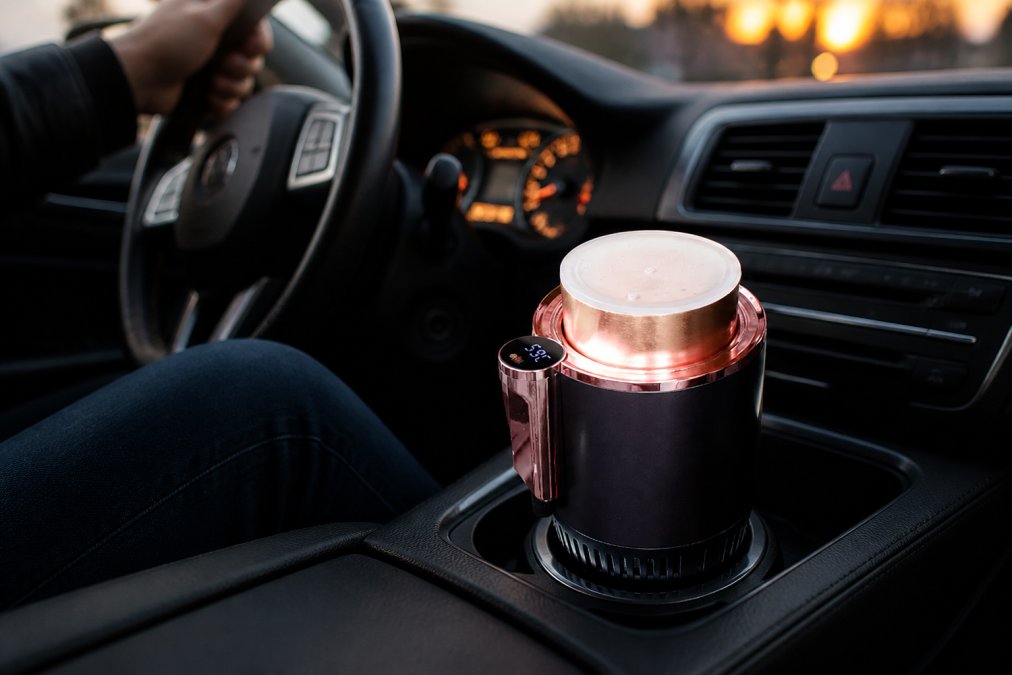
Electric car cup warmers plug into a vehicle's 12V outlet or USB port and actively maintain temperature for as long as the car is running. Unlike passive insulation, these devices replace heat as it's lost, which means your coffee stays at your target temperature rather than slowly declining toward room temperature.
The Jackie's Attic 2-in-1 Smart Car Cup Warmer/Cooler ($51.81) takes this further with an intelligent temperature control system that switches between heating and cooling modes. The digital display provides real-time temperature readings, so you're not guessing whether your coffee is still at drinking temperature. For commuters who want to keep coffee hot during long commutes without thinking about it, active temperature control removes the variability entirely.
A few things to know about vehicle heating solutions:
- They work best with standard cylindrical mugs that fit snugly in the warming cradle.
- Heat-up time from room temperature is typically 15 to 20 minutes, so they're better for maintaining temperature than recovering a cold drink.
- USB-powered versions draw less power and heat more slowly than 12V versions.
- Most commuters consume their beverages within 2 to 3 hours, meaning a good active warmer covers the vast majority of real-world commute scenarios.
For road trips where you want both hot coffee and cold drinks in the same cup holder, a 2-in-1 warmer/cooler unit is genuinely more practical than carrying separate solutions.
Keeping coffee hot during long commutes comes down to three things working together: a quality vacuum-insulated container, consistent preparation habits (especially preheating), and the right in-car solution for your commute length. Jackie's Attic carries both the Smart Digital Thermal Bottle for everyday commutes and the 2-in-1 Smart Car Cup Warmer/Cooler for drivers who want active, precise temperature control on longer drives. Add either to your setup and stop settling for lukewarm coffee halfway to work.
=== FAQ ANSWERS (audit these too, same rules) ===
[1] Q: Does preheating a travel mug actually help keep coffee hot? A: Yes, it makes a measurable difference. Filling your mug with hot water for 60 seconds before adding coffee can add 20 to 30 minutes of effective heat retention. A cold container acts as a heat sink, pulling warmth out of your coffee the moment you pour it in. Preheating brings the walls to a temperature closer to your coffee, so the thermal equilibrium point is much higher from the start.
[2] Q: How do I keep coffee hot for 12 hours during a long commute or road trip? A: A quality double-wall vacuum insulated thermos is your best option. Modern vacuum-insulated containers can keep coffee hot for 8 to 24 hours depending on build quality. Preheat the container, fill it to capacity to minimize the air gap, and avoid opening the lid unnecessarily to reduce heat leakage.
[3] Q: What is the 2-hour rule for coffee? A: The 2-hour rule is a general food safety guideline: brewed coffee left at room temperature should be consumed within 2 hours before bacterial growth and oxidation noticeably degrade both safety and flavor. Inside a sealed, vacuum-insulated thermos that keeps coffee above 140°F, the safety concern is reduced, but flavor still degrades over time as volatile aromatic compounds evaporate even in a hot, sealed environment.
[4] Q: Can a car cup warmer actually keep coffee hot for a full commute? A: Active car cup warmers that plug into your vehicle's USB port or 12V outlet can maintain your chosen temperature for as long as the car is running, making them a strong option for longer drives where passive insulation alone falls short. Smart models with a digital display let you set a precise target temperature. Most commuters consume their coffee within 2 to 3 hours, so a good warmer paired with an insulated mug covers nearly any commute length.
Frequently Asked Questions
Q: Does preheating a travel mug actually help keep coffee hot?
A: Yes, it makes a measurable difference. Filling your mug with hot water for 60 seconds before adding coffee can add 20 to 30 minutes of effective heat retention. A cold container acts as a heat sink, pulling warmth out of your coffee the moment you pour it in. Preheating brings the walls to a temperature closer to your coffee, so the thermal equilibrium point is much higher from the start.
Q: How do I keep coffee hot for 12 hours during a long commute or road trip?
A: A quality double-wall vacuum insulated thermos is your best option. Modern vacuum-insulated containers can keep coffee hot for 8 to 24 hours depending on build quality. Preheat the container, fill it to capacity to minimize the air gap, and avoid opening the lid unnecessarily to reduce heat leakage.
Q: What is the 2-hour rule for coffee?
A: The 2-hour rule is a general food safety guideline: brewed coffee left at room temperature should be consumed within 2 hours before bacterial growth and oxidation noticeably degrade both safety and flavor. Inside a sealed, vacuum-insulated thermos that keeps coffee above 140°F, the safety concern is reduced, but flavor still degrades over time as volatile aromatic compounds evaporate even in a hot, sealed environment.
Q: Can a car cup warmer actually keep coffee hot for a full commute?
A: Active car cup warmers that plug into your vehicle's USB port or 12V outlet can maintain your chosen temperature for as long as the car is running, making them a strong option for longer drives where passive insulation alone falls short. Smart models with a digital display let you set a precise target temperature. Most commuters consume their coffee within 2 to 3 hours, so a good warmer paired with an insulated mug covers nearly any commute length.
This article was written using GrandRanker


