


Table of Contents
- The Math Behind Multi Functional Gadgets: One Device, Three Jobs
- Best Gadgets for Small Apartment Living That Earn Their Counter Space
- Space Saving Home Organization Hacks That Start With Fewer Objects
- Minimalist Gadget Essentials: What Actually Belongs in a Small Home
- How Multi Functional Gadgets Help in Decluttering a Small Home
- The Trade-Offs: Durability, Maintenance, and What Breaks First
- Frequently Asked Questions
Last Updated: September 30, 2026
The Math Behind Multi Functional Gadgets: One Device, Three Jobs
Every object in a small apartment costs you something beyond its purchase price: a slice of counter, a drawer slot, a patch of floor. Multi functional gadgets win because they pay that rent once instead of three times. A single device that charges a phone, watch, and earbuds replaces three chargers, three cables, and the tangle that comes with them.
That is the whole argument in one sentence. Space is a fixed budget, and most households spend it on duplicate tools that each do one narrow job. When you consolidate, you are not just tidying up. You are buying back surface area you already own.
The U.S. Environmental Protection Agency's guidance on reducing household waste makes a related point about consumption: fewer single-purpose items means less material entering and leaving your home over time. That is the environmental angle most decluttering guides skip entirely.
So why does this actually work? Because clutter is rarely about too many things. It is about too many things doing the same job.
Best Gadgets for Small Apartment Living That Earn Their Counter Space
The best gadgets for small apartment living share one trait: each replaces at least two objects you already own. If a device only does one thing, it has to be exceptional to justify its footprint.
At Jackie's Attic, we look for tools that collapse, fold, or combine functions without adding bulk. Here is what actually earns its place.
Charging Stations That Replace a Tangle of Cables
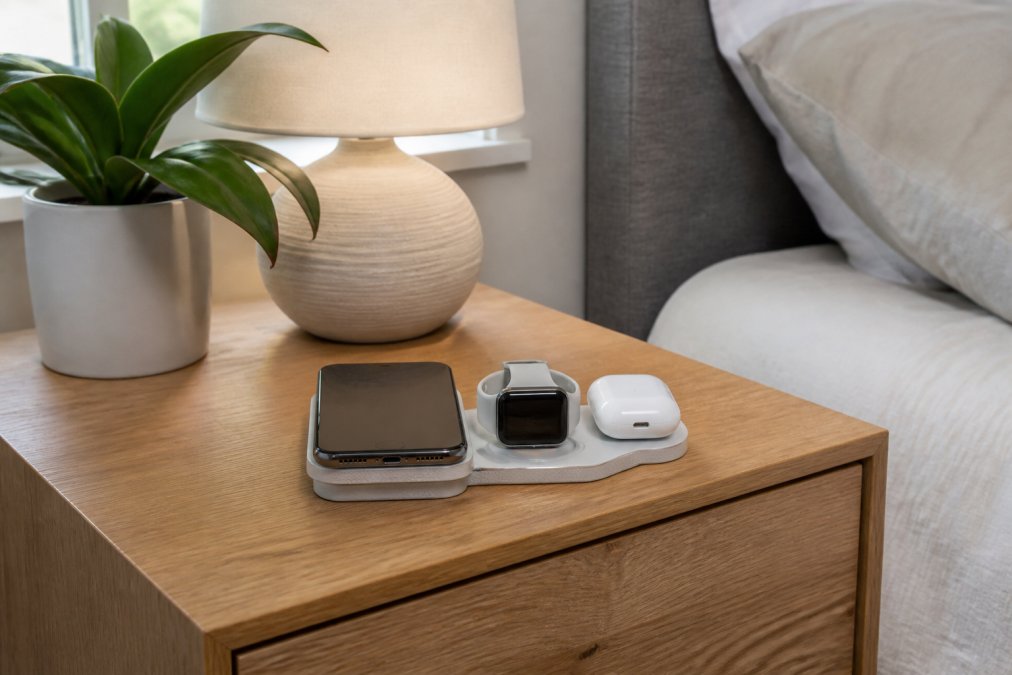
A 3-in-1 folding wireless charger handles your phone, smartwatch, and earbuds at once, then folds flat for storage or travel. At $26.16, it replaces three separate charging setups and the cable nest under your nightstand.

For desks, the 3-in-1 LED fast wireless charger stand does the same job in a standing format at $15.06, with a dual-coil design and a foldable body. If you still need a cable for an Apple Watch, the 4-in-1 multi charging cable covers four devices from one 4-foot cord at $50.71.
Kitchen and Grooming Tools That Do Double Duty
The IKAPE 58mm coffee distributor and hand tamper combines leveling and tamping in one stainless steel unit at $135.90. Espresso setups normally eat two tools' worth of counter; this one takes a single spot.

In the bathroom, the ANWA 4-in-1 rotating hair dryer brush merges a dryer, brush, and styler with two detachable heads at $146.83. One drawer slot instead of three. A 4-in-1 self-cleaning brush at $5.43 covers grooming with a built-in cleaning function.

Space Saving Home Organization Hacks That Start With Fewer Objects
Space saving home organization hacks only work when you reduce what you own, not just rearrange it. Baskets and labels hide clutter; they do not remove it. The reason is simple: storage containers consume volume too. A stack of labeled bins in a closet still occupies the same cubic feet as the loose items it holds, and it adds the bins themselves to your inventory.
The math is worth doing once. A typical small-apartment kitchen counter runs about 4 to 6 linear feet of usable surface. A single-purpose espresso tamper, a separate distributor, and a knock box can eat 18 to 24 inches of that. Consolidating the tamper and distributor into one stainless unit returns roughly a foot of counter, which is the difference between a usable prep zone and a crowded one.
Start with the one-in-one-out rule: buy a multi-purpose tool, remove the single-purpose items it replaces. Then apply these:
- Clear one surface completely and put back only what earns a spot
- Group items by job, not by room
- Replace any three single-use tools with one multi-purpose version
- Route cables behind furniture or into a single charging hub
- Store folding or collapsible items in the space they free up
- Measure the footprint of each replacement before buying, not after
- Keep a donation box running so removed items leave the home the same week
The U.S. Department of Energy's home energy and appliance guidance notes that consolidating devices can also trim standby power draw. Fewer plugged-in gadgets means less constant drain. A single 3-in-1 charging station draws one standby load instead of three, and the savings compound across every outlet in the home.
3-in-1 Folding Wireless Charger →
There is an environmental layer most organization guides skip. Fewer single-purpose items means less material extracted, manufactured, shipped, and eventually discarded. The [U.S.
The psychological payoff is real, and most guides ignore it. A clear counter reduces the low-grade friction of constantly moving things out of the way. Researchers who study clutter consistently find that visual disorder competes for attention, and a surface that stays clear removes that competition. That is lifestyle improvement you feel daily, not just a tidier photo.
Minimalist Gadget Essentials: What Actually Belongs in a Small Home
Minimalist gadget essentials are the tools you use weekly that replace at least one other object. Everything else is optional. The test is not whether an item is nice to have. It is whether removing it would force you to bring back two or more single-purpose items.
A practical short list for a small home:
- Charging: one folding 3-in-1 station for phone, watch, and earbuds
- Kitchen: a 2-in-1 espresso distributor and tamper if you brew at home
- Grooming: a 4-in-1 styler or self-cleaning brush
- Utility: a multi-purpose fan, light, and power bank for outages and travel
- Car: a temperature-controlled cup warmer or cooler for commutes
The Durability Filter Most Lists Skip
Before any gadget earns a spot, run it through three questions. First, what does it replace, specifically? Second, what is the most likely failure point, and can you maintain it? Third, does the build quality justify the footprint it holds?
The Sustainability Case for Fewer, Better Gadgets
Minimalism is usually framed as a space and money play. It is also an environmental one. Every single-purpose tool you decline to buy is material that never gets mined, molded, shipped, and eventually landfilled. The U.S. Environmental Protection Agency's guidance on reducing household waste places source reduction at the top of the waste hierarchy for exactly this reason: the cleanest waste is the waste you never create.
How Multi Functional Gadgets Help in Decluttering a Small Home
Here is the decision framework we use:
| Situation | Action | Why It Works |
|---|---|---|
| Three chargers, one outlet | Replace with a 3-in-1 station | Frees two outlets and a cable pile |
| Two espresso tools | Switch to a 2-in-1 distributor/tamper | One counter footprint |
| Dryer plus brush plus iron | Use a 4-in-1 styler | One drawer slot |
| Fan, flashlight, power bank | Combine into one unit | Three items out, one in |
The psychological payoff is real, and most guides ignore it. A clear counter reduces the low-grade friction of constantly moving things out of the way. That is lifestyle improvement you feel daily, not just a tidier photo.
The Trade-Offs: Durability, Maintenance, and What Breaks First
Multi-purpose devices carry real trade-offs, and honest guides name them. When one unit does three jobs, a single failure can take out all three functions at once.
What typically breaks first:
- Charging stations: the folding hinge or the magnetic alignment pad
- Stylers: the rotating brush mechanism and the heating element
- Power banks: battery capacity fade after repeated full cycles
Frequently Asked Questions
How do multi-functional gadgets help in decluttering a small home?
Every multi functional gadget replaces two or three single-purpose items, so you remove objects rather than add them. A 3-in-1 folding wireless charger, for example, handles a phone, watch, and earbuds from one spot on the nightstand, which clears the cables and adapters those three devices would otherwise need. Fewer objects means fewer surfaces to store, dust, and work around. The space savings come from subtraction, not from clever stacking.
What should I look for when buying space-saving gadgets?
Check three things: how many jobs the device actually does, whether it folds or stores flat when not in use, and whether the build materials hold up to daily handling. A folding design matters more than a small footprint, because flat storage frees drawer space. Also confirm the specs match your devices, such as a 58mm portafilter fit for an espresso tamper or Qi certification on a wireless charger. Skip anything that only saves space in the marketing photos.
Are multi-functional gadgets more sustainable than single-use items?
They reduce the total number of products you buy, ship, and eventually discard, which lowers material and packaging waste over time. One device doing three jobs means one box, one power adapter, and one end-of-life disposal instead of three. The environmental gain depends on how long the device lasts, so durable construction matters as much as consolidation. Buying fewer, longer-lasting items is the practical version of minimalism for most households.
Can multi-functional gadgets actually save money in the long run?
Often yes, because you buy one item instead of two or three. A 2-in-1 coffee distributor and tamper at $135.90 replaces separate tools that would each cost money and take up counter space. The same logic applies to a $26.16 folding wireless charger standing in for multiple charging cables and stands. The savings show up twice: once at checkout and again when you are not replacing three cheap items that wore out.


